
The core characteristic that distinguishes aluminum foil bowls from ordinary aluminum foil trays lies in their high-drawing-ratio forming—deeper bowl walls, smaller corner radii, and significantly thinner bottom and sidewalls. This presents a much higher technical barrier to the plasticity, isotropy, and microstructure uniformity of the aluminum foil rolls compared to conventional containers. Haomei Aluminum has developed aluminum foil for aluminum foil bowl production, optimizing alloy formulations and annealing processes based on deep-drawing mechanisms. These aluminium foil rolls are reliably compatible with the mass production needs of various deep-cavity containers, including clay pot rice bowls, dessert bowls, instant noodle bowls, and sauce cups.
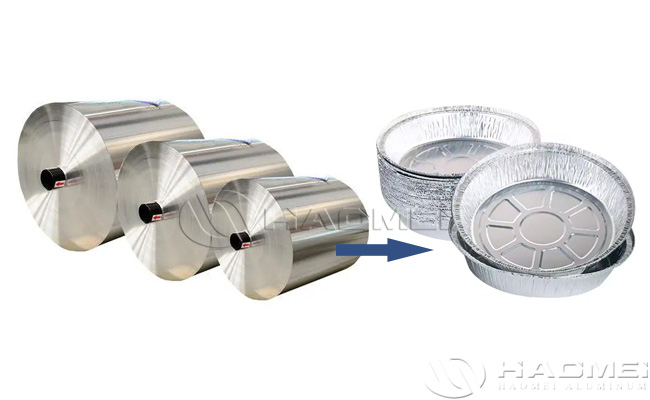
From an alloy system perspective, the aluminum foil for making aluminum foil bowls follows a selection logic based on drawing depth.
8011-O aluminum foil is the primary material for basic models, with an optimized iron-silicon ratio of 0.7%–0.9% iron and 0.6%–0.8% silicon. The dispersed distribution of second-phase particles coordinates plastic deformation, making it suitable for shallow bowls and sauce cups with drawing ratios up to 1:0.6. Its outstanding cost-effectiveness makes it the mainstream choice for disposable catering bowls.
For deep-cavity products such as clay pot rice bowls and large-capacity soup bowls, 3003-O aluminum foil performs better. Manganese solid solution strengthening results in a tensile strength of 110–140 MPa, elongation ≥25%, and a cupping value consistently above 7.5 mm. During deep drawing, the sidewalls thin evenly, reducing the likelihood of bottom thinning or sidewall cracking.
The higher-specification 8006 alloy is primarily used for high-end, thickened aluminum foil bowls, with an iron content of 1.2%–1.7%. It exhibits low springback after forming and high rim stiffness, making it suitable for reusable semi-rigid bowls.
In terms of specifications, aluminum foil bowl raw material aluminum foil rolls are available in clearly defined thickness tiers based on bowl type and capacity. Standard disposable small bowls (200–500ml) use a thickness of 0.045mm–0.06mm, balancing formability and material cost; mainstream takeaway clay pot rice bowls (600–1000ml) use a thickness of 0.06mm–0.09mm, accounting for over 60% of the market share; large-capacity soup bowls and baking bowls (1200–2000ml) use a thicker specification of 0.10mm–0.15mm to ensure stacking load-bearing capacity and no deformation under high temperatures. The roll width is customized according to the unfolded dimensions of the bowl blank, covering 80mm–620mm. The roll diameter and core inner diameter can be matched to the customer’s stamping machine feed rack, supporting large roll weight supply to reduce roll changedown time.
Deep drawing requires strict material consistency; aluminum foil rolls for making bowls adheres to multiple specific quality control standards. Thickness tolerance is controlled within ±0.001mm, with longitudinal thickness deviation within the same roll ≤3%, ensuring stable tensile force and uniform bowl wall thickness during stamping. Pinhole detection on the plate surface is rigorously enforced, with zero pinholes larger than φ0.08mm per square meter, preventing leakage of soup. The material undergoes a homogenization annealing process, with the ear-making rate controlled below 4%, reducing burrs and waste at the bowl rim. A food-grade light oiling process is applied to the surface, with an oiling amount of 12–25mg/㎡ adjustable as needed, effectively reducing mold friction during deep drawing, resulting in smooth demolding of the finished bowl without oil residue. All products have passed FDA and EU 10/2011 food contact safety certifications, with a temperature resistance range of -40℃ to 230℃, allowing direct placement in ovens, steamers, or open flame heating.
Haomei Aluminum supports customized annealing hardness and oiling amount based on customer mold parameters, stamping speed, and bowl depth; the technical team can assist in adjusting molding process parameters. Large-scale production capacity ensures stable delivery of large orders, dollar-denominated pricing is linked to international aluminum ingot prices, and export products are packaged in moisture-proof, waterproof, and sealed packaging suitable for ocean shipping, providing global aluminum foil bowl manufacturers with full-chain support from material selection to mass production.
