
In the field of air conditioning heat exchangers, aluminum foil plays a crucial role as a core heat-conducting material, and its technological evolution directly determines the energy efficiency and lifespan of air conditioners. As an aluminium foil manufacturer with over a decade of experience in the industry, I have witnessed the leap in air conditioning aluminum foil from simple plain/bare aluminum foil to composite functional materials. We are well aware of the differences in performance, applications, and market demands among different types of air conditioner aluminum foil.
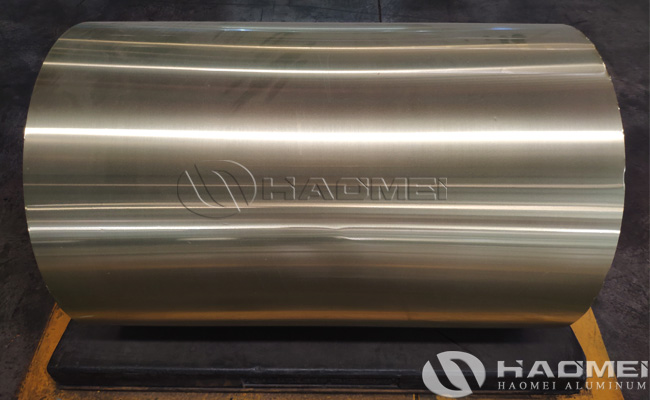
Based on years of production and application verification, the classification of air conditioning aluminum foil must adhere to the dual core of “heat exchange scenario + functional requirements,” and can be broadly categorized into four types: ordinary plain/bare aluminium foil, hydrophilic aluminium foil, hydrophobic aluminium foil, and corrosion-resistant aluminium foil.
- 1. Uncoated Aluminium Foil
Ordinary plain/bare aluminum foil is the basic type of air conditioning aluminum foil, primarily positioned for low-operating-condition, low-cost heat exchange scenarios. Its principle relies on the excellent thermal conductivity of aluminum itself, and the rolling process ensures surface flatness, reducing airflow resistance.
From a specifications perspective, commonly used alloy grades are 1235 and 8011. Both alloys have an aluminum content ≥99.3%, a thermal conductivity of 200-205 W/(m·K), a thickness range of 0.08-0.15 mm, and a width adapted to the air conditioner heat exchanger fin design of 500-1250 mm. The rolling precision error is ≤±0.005 mm.
The advantages lie in its excellent processing performance; it can be directly stamped and bent, making it suitable for small window units, low-end wall-mounted units, and other products with low heat exchange efficiency requirements. It also boasts lower production costs and strong stability in mass production.
It should be noted that bare aluminum foil has no special surface treatment and is prone to condensation in high humidity environments, requiring an additional drainage structure.
- Hydrophilic Aluminum Foil
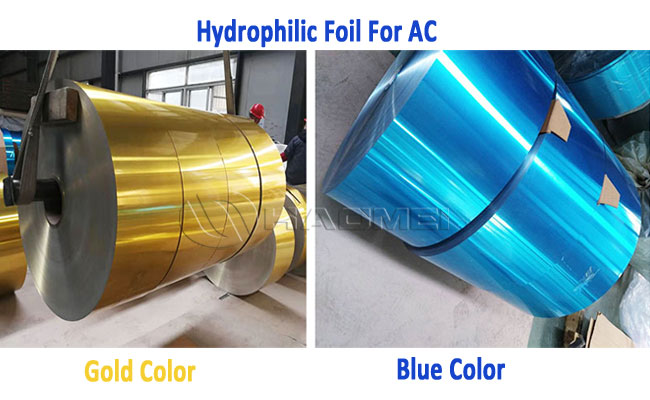
Hydrophilic aluminum foil is currently the preferred type for mainstream air conditioners (especially wall-mounted and floor-standing units), primarily addressing the condensation problem in high humidity environments. The core technology involves coating a nano-scale hydrophilic coating onto the surface of ordinary optical foil. By reducing the water contact angle (≤15°), condensate quickly spreads into a water film and slides off, preventing water droplets from clogging the fin gaps.
In terms of specifications, the substrate is still mainly 1235 and 8011 alloys, with the coating thickness controlled at 0.8-1.2μm. The coating adhesion is ≥3B grade (cross-cut test), and water resistance is demonstrated by 1000 hours of boiling water immersion without peeling. The thermal conductivity is slightly lower than that of ordinary optical foil, but still remains above 195W/(m·K), and the thickness tolerance is also ≤±0.005mm.
The advantages lie in a significant improvement in heat exchange efficiency. Compared to ordinary optical foil, it can reduce wind resistance by 10%-15%, increasing air conditioning cooling capacity by 5%-8%, while reducing noise from condensate dripping. It is compatible with the indoor unit heat exchangers of most residential and commercial air conditioners.
- 3. Hydrophobic Aluminum Foil
In contrast to hydrophilic aluminum foil, hydrophobic aluminum foil achieves a contact angle >75° through a fluorocarbon resin coating, creating a “lotus effect.” The technical challenge lies in simultaneously achieving a high contact angle and low surface energy: a German product uses nano-grade silica-modified fluororesin, maintaining an 85° contact angle while reducing the surface energy to 22 mN/m, resulting in a condensate roll-off angle <5°.
Specification Innovation: 0.08mm ultra-thin hydrophobic foil has achieved industrial production. In offshore drilling platform air conditioning systems, its salt spray resistance is 300% higher than plain foil, extending the maintenance cycle to 5 years.
- 4. Corrosion-resistant aluminum Foil
Corrosion-resistant aluminum foil is mainly suitable for harsh working conditions, such as environments with high concentrations of salt spray and corrosive gases, such as near the sea or chemical plants. Its principle is to achieve corrosion protection through a double-layer coating structure: the bottom layer is a chromate conversion film (0.2-0.3μm thick), forming a basic anti-corrosion barrier; the surface layer is a fluorocarbon or polyester anti-corrosion coating (1.5-2.0μm thick), isolating corrosive media from contact with the aluminum substrate.
In terms of specifications, the alloy used is 3003 aluminum alloy with stronger corrosion resistance, a thermal conductivity of 180-185W/(m·K), a thickness of 0.10-0.18mm, and it shows no rust after passing a neutral salt spray test for ≥1000h.
The core advantage is its excellent anti-corrosion performance, which can extend the service life of air conditioning heat exchangers to more than 15 years, far exceeding the 8-10 years of ordinary aluminum foil. It is mainly used in air conditioning for seaside villas, industrial workshops, and other special applications.
Different types of air conditioner aluminum foil provide air conditioning manufacturers with a wide range of choices. The selection of air conditioning aluminum foil needs to be precisely matched with the usage environment, performance requirements, and cost budget. As an aluminium foil manufacturer with both production and export qualifications, we can provide customized alloy ratios, specifications, and surface treatment solutions based on customers’ specific operating conditions to ensure that the performance of aluminum foil is perfectly matched with the heat exchanger design.
