
When consulting with global clients, I often encounter a common selection misconception: many buyers only focus on the alloy grade and thickness, ignoring the delivery condition, and use hard temper 8021 aluminum foil for deep drawing, ultimately resulting in batches of edge cracking and insufficient forming. As a technician at Haomei Aluminum responsible for optimizing the 8000 series aluminum foil process, I firmly believe that the O temper is the state in which the 8021 aluminum alloy truly releases its performance advantages—through complete recrystallization annealing, the rolling stress is thoroughly released, preserving the alloy’s strength advantages while optimizing forming toughness and fit, making it a cost-effective choice for forming and composite applications.
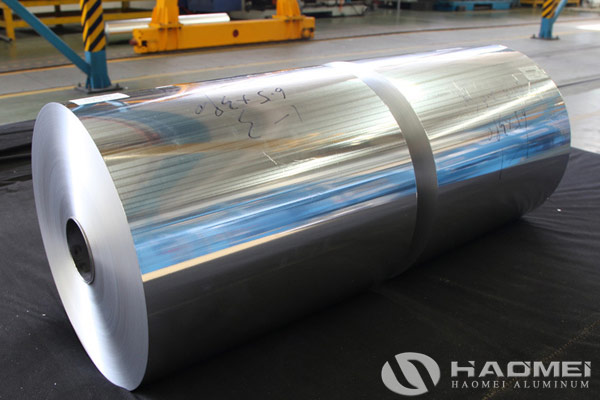
8021 O aluminium foil belongs to the Al-Fe-Si alloy system, with iron and silicon content controlled at 0.6%-1.2% and 0.4%-0.8% respectively. The dispersed precipitated second-phase particles give it superior strength and corrosion resistance compared to 1-series aluminum foil. Our 8021 O temper aluminum foil covers the full thickness range: thin specifications include 6μm-9μm double-zero foil, medium-thin specifications are 0.01mm-0.08mm, and medium-thick specifications can be extended to 0.2mm. Standard widths range from 100mm to 1650mm, and we support large-diameter master rolls up to 2.5 tons. In terms of core performance, the 0.03mm-0.1mm standard specifications have a stable tensile strength of 75-105MPa, elongation after fracture ≥20%, cupping test value ≥7.0mm, and plasticity far exceeding that of H18 hard-state products of the same thickness; double-zero specifications have an elongation ≥15%, pinhole rate controlled below 15/㎡, excellent barrier properties, oxygen permeability ≤0.5cm³/(m²·24h·0.1MPa), and water vapor permeability ≤0.3g/(m²·24h), fully meeting the sealing requirements of food and pharmaceutical packaging.
The core quality of 8021-O aluminium foil lies in the precise control of the annealing process, a point I deeply understood during my early experience debugging large-coil annealing lines. Because 8021 aluminum foil has more second-phase particles, its recrystallization temperature is higher than that of 1000 series high-purity aluminum. Initially, when annealing using conventional processes, incomplete recrystallization of the coil core and coarse grains on the outer surface were common problems, resulting in a hardness difference exceeding 20 MPa across the entire coil. Downstream customers reported uneven hardness. Later, our team redesigned the annealing curve, adopting a stepped heating + segmented holding process, combined with optimized furnace airflow, locking the furnace temperature control accuracy within ±1℃. We dynamically adjusted the holding time according to the coil weight and thickness, ultimately reducing the overall coil hardness deviation to within 8 MPa, completely solving the industry-wide problem of uneven annealing in large coils. Simultaneously, we optimized the final rolling pass processing rate, stabilizing it above 75%, ensuring uniform and fine grains after annealing and preventing orange peel defects on thicker products.
With its balanced strength and excellent ductility, 8021 O aluminum foil possesses irreplaceable selection advantages in multiple niche applications. Double-zero grade O temper aluminum foil is widely used in food vacuum composite bags and pharmaceutical blister pack bottom foil; its soft state provides excellent adhesion, reduces wrinkling after lamination, and offers higher registration accuracy. The 0.02mm-0.08mm medium-thin specification is the mainstream substrate for aluminum-plastic composite pipes and cable shielding tapes; it can be bent synchronously with the pipe without cracking, making it a core product for our water supply and drainage building materials customers in the Middle East and Southeast Asia. The 0.08mm-0.2mm medium-thick specification is primarily used for deep drawing, in disposable food containers and lithium battery soft-pack shells; when stamping deep-cavity products, the bottom thinning is more uniform, increasing the yield by more than 10% compared to rigid state products.
Currently, Haomei 8021-O aluminium foil has an annual production capacity of 18,000 tons. Our products are FDA, EU 1935/2004, and RoHS certified. We support customized slitting and surface treatment, and our products use five-layer vacuum moisture-proof packaging suitable for ocean shipping. We can provide directional performance tuning and sample support according to customers’ molding processes.
