
8021 aluminum foil serves as the essential barrier layer in the aluminum-plastic films used for soft-pack lithium-ion batteries. It plays a critical role in blocking moisture and oxygen, preventing electrolyte leakage, and enhancing the structural integrity of the packaging—factors that directly determine a battery’s cycle life, safety, and reliability. Haomei Aluminum has specifically optimized 8021 aluminum foil production process for new-energy battery packaging applications. Its products cater to the full spectrum of soft-pack battery requirements—spanning consumer electronics, electric vehicles, and energy storage systems—and are currently supplied reliably to numerous aluminum-plastic film and battery manufacturers both domestically and internationally.
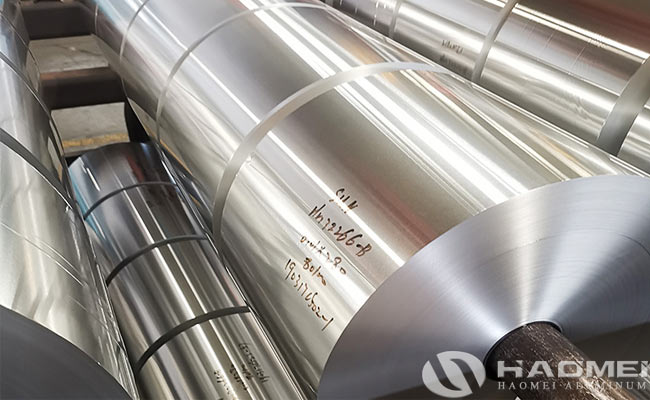
8021 aluminum foil, designed specifically for battery pouch packaging, is based on an Al-Fe-Si alloy with an iron content precisely controlled between 1.2% and 1.5%. By utilizing dispersed precipitates to enhance material properties, it meets all requirements for battery-grade materials:
– Alloy Temper: 8021-O (fully annealed/soft state); custom tempers with specific hardness levels are also available.
– Thickness Range: 25μm–45μm (standard specifications include 30μm, 35μm, and 40μm), with a thickness tolerance controlled within ±2μm.
– Width Range: 100mm–1650mm, customizable to match the specifications of your aluminum-plastic film lamination and slitting equipment.
– Coil Weight: Up to 2 tons per coil, designed for high-speed, continuous lamination production lines to minimize downtime during coil changes.
– Compliance & Standards: Meets international standards such as ASTM B209 and EN 485; certified under the IATF 16949 quality management system for the automotive industry.
Key Performance Characteristics of 8021 aluminum foil for battery soft package:
1. Stable Deep-Drawing Performance for Various Battery Casing Sizes
In the O-temper, the 8021 battery aluminum foil exhibits a tensile strength of 85–105 MPa, with an elongation at break ranging from 15% to 26% (depending on thickness). It achieves an Erichsen cupping test value of ≥7.0 mm, ensuring uniform wall-thickness reduction during the forming process without micro-cracking at the corners. When working with a energy storage battery client, we observed that standard aluminum foils often developed latent corner cracks during deep-drawing (at depths exceeding 6 mm). By optimizing the annealing and holding temperature profile of our 8021 aluminium foil to suit the client’s specific tooling parameters, we stabilized the elongation at over 22%. Consequently, the client’s yield rate for battery casings with an 8 mm draw depth increased from 88% to over 97%.
2. Low Pinhole Density and High Barrier Properties for Long-Term Battery Safety
Pinholes are the primary risk factor for moisture ingress in pouch-cell batteries. Through strict control of raw material cleanliness and optimization of the rolling process, we maintain a pinhole density of ≤5 per m² in our finished products—with high-end, customized versions achieving ≤3 per m²—and ensure the complete absence of any through-thickness pinholes exceeding 0.1 mm in diameter. Our products offer a water vapor transmission rate significantly lower than the industry standard, effectively blocking external moisture from entering the battery cell while preventing electrolyte leakage. This extends the battery’s shelf life at room temperature by more than 30%.
3. Excellent Surface Compatibility for Reliable Lamination
Our surface treatment process ensures low residual oil levels (≤2 mg/m²) and is free from oil stains, color variations, or roller marks. With a surface wetting tension of ≥72 dyn/cm, the material exhibits superior adhesion to nylon and CPP films. The resulting lamination offers stable peel strength and remains resistant to delamination, even after prolonged exposure to electrolytes. The material also demonstrates exceptional resistance to electrolyte corrosion; after 72 hours of immersion in electrolyte at 85°C, the surface shows no signs of corrosion, and the material retains ≥90% of its original mechanical properties.
Haomei Aluminum operate dedicated production lines for battery-grade aluminum foil, implementing a closed-loop management system that spans the entire process—from raw material melting and casting to the final annealing stage. At the raw material stage, we employ three-stage ceramic filtration and two-stage in-line degassing to strictly control impurity particle size and hydrogen content. Throughout the rolling process, X-ray thickness gauges and in-line surface defect detection systems monitor parameters across the entire width of the foil in real time. Finished coils are processed in a continuous air-cushion annealing furnace, ensuring high consistency with a hardness variation of ≤5 HV across the entire length of the coil.
We currently have an annual production capacity of 5,000 tons of 8021 aluminum foil for battery soft package. Standard specifications can be delivered within 15–20 days, and we support the provision of customized samples and small-batch trial production. All products intended for export are vacuum-sealed in moisture-proof packaging, making them suitable for long-distance ocean transport. Furthermore, we provide technical support to assist customers in optimizing their lamination process parameters. Please contact our technical sales team to obtain detailed technical specifications or free samples.
