
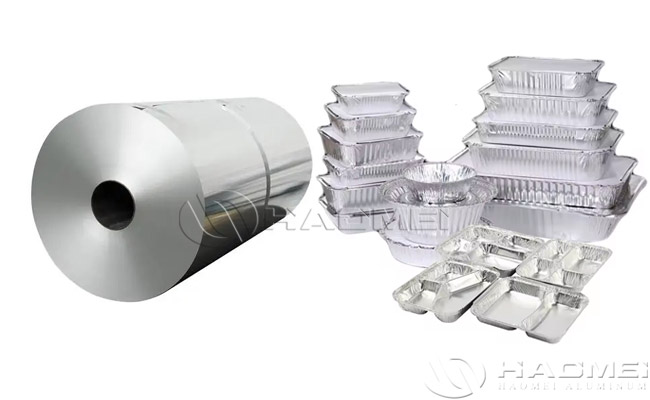
8011 H22/H24 are semi-hard container foils produced through cold-rolling (for work hardening) followed by partial recrystallization annealing. This process ensures a balance between formability and enhanced rigidity/deformation resistance, making them the preferred substrate for shallow-drawn aluminum containers and sealing lids. Haomei Aluminum has optimized its annealing process for container applications that require shallow stamping and high stackability. Haomei 8011 aluminium container foil offers uniform hardness and consistent batch-to-batch quality, making it ideal for the automated production lines used by global food service packaging and food processing companies.
Key Specifications and Performance Parameters
Based on the 8011 aluminum-iron-silicon alloy, container foil products achieve distinct performance characteristics through the precise control of cold-rolling reduction rates and annealing parameters.
– Temper Distinction: The H22 temper involves low work hardening combined with full annealing, offering a balance of plasticity and foundational rigidity; the H24 temper involves moderate work hardening combined with partial annealing, resulting in higher strength and superior resistance to deformation.
– Mechanical Properties: In the H22 temper, the material exhibits a tensile strength of 90–130 MPa and an elongation of 15%–25%, making it suitable for light deep-drawing and bending processes. In the H24 temper, it offers a tensile strength of 120–150 MPa and an elongation of 6%–12%, prioritizing high rigidity and shape retention.
– Dimensions and Specifications: Thickness ranges from 0.03 mm to 0.15 mm, with 0.04 mm, 0.06 mm, and 0.08 mm available as standard, widely used specifications. Width can be customized (between 300 mm and 1650 mm) to align with stamping die layouts. Each coil can weigh up to 2.5 tons and comes with a standard 152 mm core, designed for high-speed continuous stamping operations.
– Safety and Surface Quality: The pinhole count is ≤0.1 per m², ensuring a complete barrier against oil and water penetration. Surface residual oil is ≤3 mg/m², with no unpleasant odors. Food-grade versions are certified under FDA 21 CFR and EU 1935/2004 standards; they withstand temperatures from -20°C to 220°C, making them ideal for baking and steaming applications.
Key Advantages for Container Applications
1. High Rigidity and Deformation Resistance: No Collapse During Stacking and Transport
Semi-hard (H-temper) aluminum foil possesses a significantly higher yield strength than soft (O-temper) foil. Once formed, containers feature well-defined edges and minimal spring-back, making them highly resistant to deformation under pressure when stacked. In one instance, I worked with a food-delivery restaurants on their container lids. They previously used O-temper aluminum foil, which frequently resulted in dented lids and compromised seals during delivery and stacking. After switching to the H24 temper, the lids’ resistance to denting improved by over 40%. In a stress test involving a stack of 100,000 units, there was no deformation or damage, leading to an 80% reduction in customer complaints.
2. High Precision for Shallow Stamping and High-Speed Mass Production
Food containers aluminium foil retain ample plastic margin, making them well-suited for processes such as shallow stamping, flanging, and curling. The edges remain clean and burr-free after stamping, with dimensional deviations kept to ≤0.1 mm. Enhanced by high-precision strip-shape control—achieving a flatness of ≤8 I-units—the material feeds smoothly without drifting. It is fully compatible with automated production lines operating at speeds exceeding 600 strokes per minute, consistently maintaining a stamping yield of over 98%.
3. Excellent Surface Compatibility for Coating and Printing
The pristine, uniform surface of 8011 aluminum foil is ready for immediate post-processing, including internal coating, lamination, and printing. The coating achieves Grade 0 adhesion—ensuring no peeling or blistering—meeting the customized aesthetic requirements of premium food and beverage brands.
Main Applications and Selection Guide
The 8011 H22 aluminum foil offers superior plasticity, making it ideal for products requiring light forming, such as egg tart shells, sauce cups and shallow baking trays. The 8011 H24 aluminium foil provides greater rigidity, making it the preferred choice for sealing components that require structural strength, such as lids for takeout containers, yogurt cups, airline meal trays, and disposable nut canisters. Regarding thickness, 0.03–0.05 mm is suitable for small lids and shallow trays, while 0.06–0.1 mm is appropriate for standard food container lids and medium-sized trays.
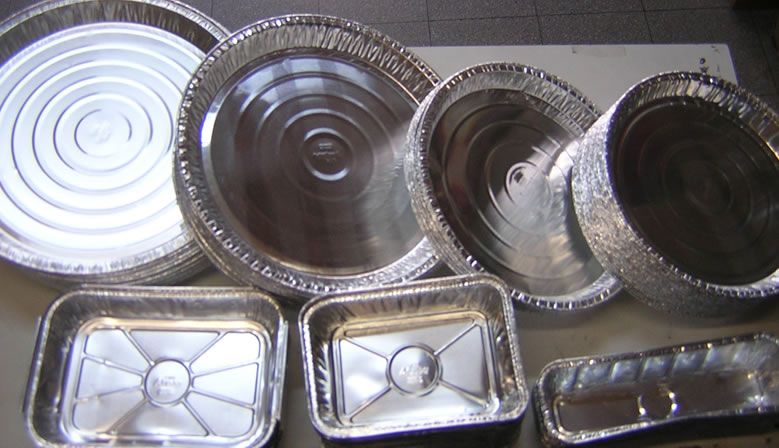
We operate a dedicated production line for container foil with an annual capacity of 30,000 tons. Standard specifications can be delivered within 15 days; we also support small-batch sampling and customized hardness adjustments. For export, products are secured in five-layer vacuum moisture-proof packaging, designed to withstand long-distance ocean freight. We also provide technical support, including the optimization of stamping process parameters and guidance on mold compatibility. Please contact our sales and technical team to request detailed technical specifications or free samples.
