
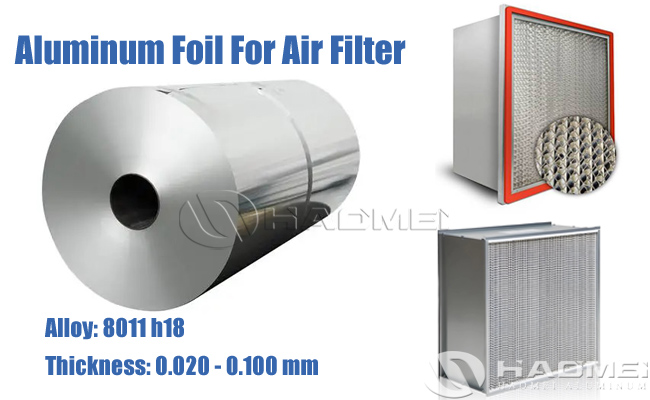
8011 H18 aluminum foil is a widely used material for air filter separators, primarily serving HEPA high-efficiency filters, sub-HEPA filters, cleanroom filters, HVAC filters, and certain industrial dust collection systems. Its main function is to maintain stable spacing between pleated glass fiber filter media, ensuring uniform airflow through the filter element while supporting the pleats to prevent spacing irregularities, adhesion between layers, or localized collapse.
8011 h18 aluminum foil for filter separators typically undergoes processes such as embossing, pleating, slitting, and cut-to-length operations. Material hardness, thickness uniformity, coil flatness, and edge quality all influence embossing performance, filter assembly, and final product consistency. Thanks to its moderate rigidity and excellent pleat retention after forming, 8011 H18 aluminum foil has become a key raw material for separator-style air filters.
Composition Characteristics of 8011 Alloy
8011 belongs to the Al-Fe-Si alloy series; it features an aluminum base with additions of iron and silicon to enhance strength and processing stability. In terms of typical composition ranges, 8011 alloy generally contains 0.50%–0.90% silicon (Si) and 0.60%–1.00% iron (Fe), with copper (Cu) ≤ 0.10%, manganese (Mn) ≤ 0.20%, magnesium (Mg) ≤ 0.05%, and zinc (Zn) ≤ 0.10%; the remainder consists of aluminum and trace impurities.
Compared to 1000-series pure aluminum foil, 8011 aluminum foil offers superior strength and resistance to deformation. For filter separators, this characteristic ensures the foil retains its prescribed shape after corrugation and withstands mechanical stresses during handling, potting, framing, and long-term operation.
What does the H18 temper signify?
H18 indicates a fully hard, strain-hardened temper. The material achieves high hardness and rigidity through cold rolling, resulting in relatively low elongation. This temper is ideal for industrial aluminum foil products requiring shape retention, such as filter separators, radiator fins, certain packaging frameworks, and stamped support components.
When used in filters, the H18 temper offers three key advantages:
Minimal spring-back after embossing. Once rolled into a corrugated or fluted structure, the foil maintains stable wave heights and pitches.
Excellent structural support. Positioned between filter media pleats, the rigid foil helps maintain airflow channels and minimizes changes in pleat spacing caused by wind pressure.
Suitability for continuous processing. Rigid coils offer good operational stability during unwinding, embossing, slitting, and cutting, provided that equipment tension is properly controlled.
H18 aluminum foil is not suitable for deep-drawing processes involving severe deformation. Since filter separators primarily utilize shallow embossing or pleating techniques, the material’s rigidity aligns well with application requirements.
Common Thicknesses and Widths
The common thickness range for 8011 H18 aluminum foil for filters is 0.020 mm to 0.100 mm, with 0.025 mm, 0.030 mm, 0.035 mm, 0.040 mm, 0.050 mm, and 0.060 mm being the most frequently used specifications.
Thinner gauges (0.020–0.030 mm) are suitable for smaller filters, those with low pleat heights, or applications requiring lightweight materials. Gauges of 0.035–0.050 mm are commonly used for standard high-efficiency filter separators. Gauges of 0.060 mm and above are used for industrial filters featuring greater pleat heights, larger structural dimensions, or requirements for higher separator rigidity.
Widths are typically determined by the embossing equipment and the dimensions of the finished separator, generally ranging from 20 mm to 1,300 mm. Standard inner core diameters include 76 mm, 150 mm, 300 mm, and 505 mm. For automated production lines, specifications regarding coil weight, maximum outer diameter, winding direction, and the allowable number of splices must also be confirmed.
Surface and Dimensional Quality Requirements
Aluminum foil for filter separators typically features a mill-finish surface, available in either double-sided bright or one-side bright/one-side matte finishes. The surface must be clean and free from significant oil stains, corrosion spots, cracks, pinholes, creases, and severe scratches. Edges must be smooth and flat; burrs, wavy edges, or torn edges must be avoided to prevent issues during continuous embossing and slitting.
Thickness uniformity is critical to separator quality. Significant thickness fluctuations can lead to deviations in post-embossing wave height, rigidity, and unfolded dimensions, thereby affecting the pleat pitch of the filter media. Coil formation must also be strictly controlled; coils that are too loose or too tight, or that exhibit telescoping or uneven end faces, are prone to tracking errors, strip breakage, or wrinkling during high-speed unwinding.
Key Parameters for Selection
Selecting the right 8011 H18 aluminum foil requires consideration of the filter’s structural design. First, specific dimensions—such as filter element pleat height, separator corrugation height, corrugation pitch, and embossing depth—must be confirmed. Next, equipment parameters such as roller pressure, unwinding tension, and slitting precision should be evaluated. Finally, the appropriate thickness and width are determined.
Practical processing experience shows that if the separator foil is too thin, issues such as insufficient structural support, edge damage, or collapse after assembly may occur; conversely, excessive thickness increases the load during embossing, adds weight to the filter element, and raises material costs. For newly developed filter models, it is recommended to conduct small-batch embossing and assembly tests before finalizing specifications for stable mass production.
The 8011 H18 aluminum foil produced by Haomei Aluminum is suitable for manufacturing filter separators and can be customized regarding thickness, width, core specifications, and packaging methods. For filter manufacturers, selecting aluminum foil with consistent thickness, excellent coil quality, and uniform embossing performance helps ensure continuity in production and consistency in the finished product.
