
Fins are critical thin-walled components responsible for heat exchange in air conditioners, condensers, and evaporators. As refrigerant flows through the tubes and air passes through the gaps between the fins, heat transfer occurs at the interface where the fins contact the copper tubes. The thermal conductivity, formability (specifically stamping performance), and corrosion resistance of the fin material directly determine the heat exchanger’s efficiency and service life. Aluminum foil for heat exchanger fins used in residential air conditioners, automotive condensers, and commercial chillers typically ranges from 0.08 mm to 0.15 mm in thickness; once formed, the fins can reach heights of 7–10 mm, placing strict demands on the material regarding bending spring-back and collar-forming strength.
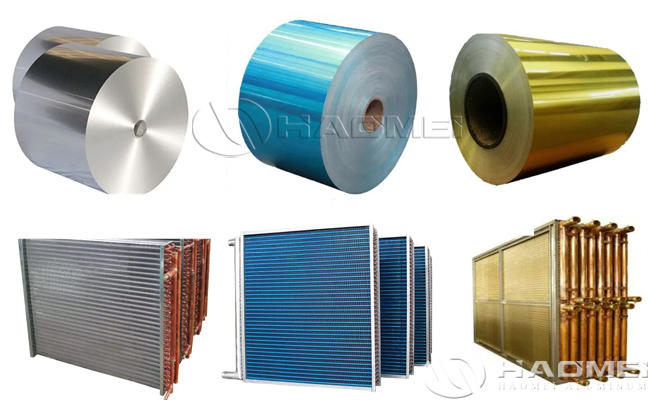
Haomei aluminum foil for heat exchanger fins product line covers two mainstream alloys: 8006 and 8011:
– Alloy Grades: 8006 (Al-Fe series; Fe content: 1.2%–2.0%); 8011 (Al-Fe-Si series; Fe: 0.5%–0.9%, Si: 0.05%–0.20%)
– Temper: O-temper (soft) for high-speed stamping; H22/H24 for coil-type heat exchangers requiring specific rigidity
– Thickness Range: 0.080mm, 0.095mm, 0.105mm, 0.115mm, 0.150mm (with 0.095mm and 0.115mm being the most common specifications in the air conditioning industry)
– Width Range: 200mm to 1300mm; customizable based on fin mold width (common widths: 650mm, 850mm, 1000mm)
– Inner Diameter: Standard 76mm core; 150mm large core available to reduce coil change frequency
– Thickness Tolerance: Within ±3%, ensuring fin consistency
Due to its higher iron content and greater degree of alloying, the 8006 alloy offers superior material strength and better resistance to spring-back after flanging compared to the 8011 alloy; it is suitable for high-speed continuous stamping and heat exchanger designs with high fin ratios. The 8011 alloy offers better plasticity and adaptability to deep drawing and bending, along with a cost advantage, making it the most widely used alloy for residential air conditioner fins.
The core performance characteristics of aluminum foil for heat exchanger fins center on stamping formability and heat transfer reliability:
– Tensile Strength: 85–115 MPa (O-temper); 120–150 MPa (H24-temper)
– Elongation: ≥18% (O-temper), ensuring no cracking during fin collar forming
– Cupping Value (Erichsen): ≥6.0 mm, verifying deep-drawing capability
– Thermal Conductivity: ≥200 W/(m·K), exceeding that of standard steel sheet materials used alongside copper tubing
– Surface Wettability: Dyne level ≥32 mN/m (uncoated); water contact angle ≤20° (after hydrophilic coating)
– Corrosion Resistance: No white rust after 48 hours of Neutral Salt Spray (NSS) testing; suitable for hot and humid operating conditions
During on-site technical support at fin manufacturing plants, I identified stamping cracks and fin collapse as the two most common process issues. Stamping cracks are often linked to insufficient material elongation or strip waviness; by optimizing the cold rolling reduction schedule and annealing curves, we control elongation fluctuations across the coil to within ±2%. We maintain strip flatness within 10 I-units and supply large-core coils, enabling customers to achieve stamping speeds exceeding 800 strokes per minute on high-speed presses without strip deviation. Residual surface oil is controlled to ≤5 mg/m² to minimize the impact of oil residue on the adhesion of subsequent hydrophilic coatings.
Haomei Aluminum offer three surface treatment options: bare foil, hydrophilic coating, and corrosion-resistant coating. Fins with hydrophilic coatings facilitate smooth condensate drainage, preventing water bridging between fins that could block airflow; the corrosion-resistant variant is ideal for outdoor air conditioning units in coastal or chemical industrial zones, extending corrosion resistance life by two to three times. All products are REACH and RoHS compliant; width tolerances and coil weights can be customized according to customer fin specifications.Please contact us for technical data sheets and free samples if you require sample testing or selection advice for specific heat exchanger models.
