
Bare aluminum foil serves as the essential substrate for various functional coatings. Its surface cleanliness, thickness uniformity, and flatness directly determine coating adhesion, application precision, and the yield rate of the final product. Haomei Aluminum optimizes bare aluminium foil properties specifically for mainstream coating processes—such as roll coating, rotogravure, and extrusion coating. Our bare aluminium foil for coating products are designed for a wide range of applications, including adhesive, carbon, and other functional coatings, and are currently supplied reliably to dozens of coating enterprises worldwide.
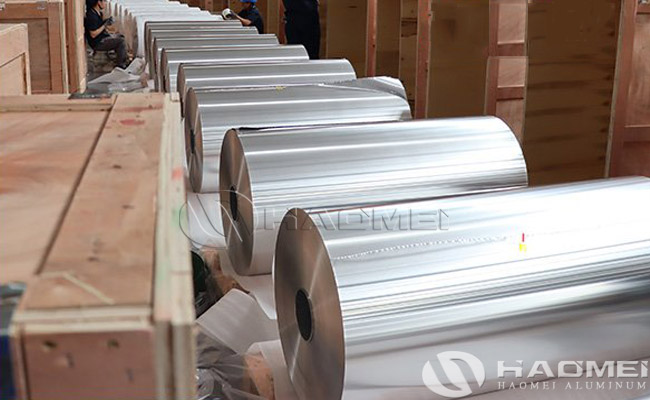
Haomei bare aluminum foil for coating applications encompasses a wide variety of alloys and tempers, allowing for flexible selection based on specific coating types and end-use operating conditions:
– Alloy Grades: 1235 and 1060 high-purity aluminum foils are designed for applications requiring high electrical conductivity and superior cleanliness, making them ideal for carbon-coated and electronic-grade coating processes. The 8011 alloy offers enhanced strength and formability, suitable for adhesive coating, color coating, and subsequent stamping operations.
– Tempers: Available in O, H14, and H18 tempers. The soft (O) temper is suited for deep-drawing processes, while the hard (H14/H18) tempers provide the necessary rigidity for high-speed, continuous coating lines.
– Thickness Range: 6μm to 200μm, with standard specifications including 9μm, 12μm, 15μm, 20μm, 30μm, and 50μm. High-precision thickness tolerances are maintained within ±2%.
– Width and Coil Weight: Widths range from 100mm to 1650mm and can be customized to match the roller width of the customer’s coating equipment. Coils can weigh up to 2.5 metric tons and come with standard 76mm or 152mm cores, ensuring compatibility with high-speed continuous coating lines and minimizing downtime during coil changes.
Three core performance made bare aluminium foil attributes for mass production coating
1. High-Cleanliness Surface for Stable Coating Adhesion
Surface cleanliness and residual oil levels are critical factors affecting coating yield. We utilize a low-residual-oil rolling process throughout production, supported by a three-stage rolling-oil filtration system. This ensures that residual oil on the finished surface is consistently kept below 2mg/m², with no oil stains, roll marks, or color inconsistencies. The surface wetting tension is typically maintained between 34–38 mN/m, with degreased options available that reach up to 72 dyn/cm. These foils are compatible with various coating systems—including water-based, solvent-based, and hot-melt adhesives—ensuring a uniform finish free from defects such as pinholes, “fish-eyes,” or localized delamination.
2. High-Precision Strip Profile for Stable High-Speed Coating
By employing an Automatic Gauge Control (AGC) system and closed-loop strip profile regulation, we ensure that thickness deviation at the head and tail of each coil is ≤2%, and transverse thickness variation is ≤1%, guaranteeing uniform coating thickness across the entire surface. The strip flatness is controlled within 10 I-units—free from defects such as edge waves or center slack—ensuring stable performance on high-speed coating lines (100–300 m/min) without strip wandering or wrinkling. Constant-tension winding ensures an end-face alignment precision of ≤0.5 mm, with no “telescoping” (uneven coil layers) or loose winding, allowing the client to feed the material directly into their production line without the need for rewinding or reprocessing.
3. Low Defect Density, Ensuring Coating Integrity
At the raw material stage, we utilize a three-stage ceramic filtration process combined with a two-stage in-line degassing system. This limits the size of inclusions in the molten aluminum to under 10 μm, effectively reducing surface particulate defects at the source. For gauges 12 μm and above, the pinhole count is ≤5 per m², with no through-thickness pinholes exceeding 0.1 mm in diameter. This prevents issues such as coating gaps or dielectric breakdown, ensuring the functional coating provides optimal barrier and protective performance.
Haomei bare aluminium foil for coating products are designed for diverse coating processes.
In the adhesive sector, they are used for self-adhesive aluminum foil, sealing lidding films, and adhesive layers in composite packaging.
For the battery industry, we provide substrates for carbon-coated and ceramic-coated aluminum foils, suitable for use as current collectors in lithium-ion batteries.
Functional coatings—including hydrophilic, anti-corrosive, and insulating layers—are utilized in applications such as air-conditioner fins, building insulation, and electronic shielding.
Additionally, for the printing and lacquering sectors—such as color-coated aluminum foil and lacquered pharmaceutical grade aluminium foil—are compatible with rotogravure, flexographic, and roller-coating processes.
Haomei Aluminum operate a production line for bare aluminium foil for coating with an annual capacity of 20,000 tons. Standard specifications can be delivered within 15–20 days; we also support small-batch sampling and customized parameter tuning. Our products meet international standards, including FDA, RoHS, and REACH certifications. For export, we utilize vacuum-sealed, moisture-proof packaging suitable for long-distance ocean freight, and we can provide expert guidance on optimizing coating process parameters. Please contact our sales and technical team to request detailed technical specifications or free samples.
