
As the technical lead at Haomei Aluminum, specializing in the R&D and production of aluminum foil for food containers for 12 years, I discuss the technical selection of aluminum foil containers with clients daily. From export experience to Asia, Africa, the Middle East, and North America, we’ve found that aluminum foil has become the preferred material for food containers due to its perfect triple match of material properties, process adaptability, and application scenarios, rather than simply market preference. Below, we break down the core reasons and key parameters from a technical perspective.
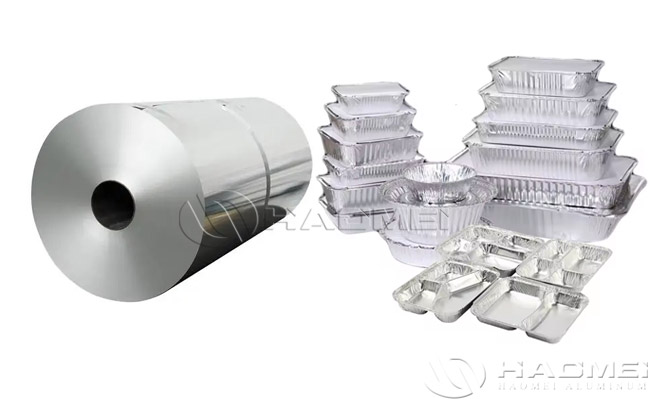
I. Core Specifications and Material Selection for Aluminum Foil in Food Containers
Haomei Aluminum offers two core substrate types for food containers: 8011-H22 and 3003-H24 aluminum alloy foils, with thicknesses ranging from 0.03mm to 0.20mm, suitable for various applications:
– Lightweight food containers: 0.03~0.06mm 8011 aluminum foil, elongation ≥12%, suitable for disposable single-compartment containers, balancing cost and performance.
– Standard containers: 0.07~0.12mm 8011/3003 aluminum foil, tensile strength 140-170MPa, meeting the needs of multi-cavity and irregularly shaped stamping.
– Reinforced utensils: 0.15~0.20mm 3003-H24 aluminum foil, yield strength ≥110MPa, suitable for reusable baking trays and insulated boxes.
We use a three-stage process of casting-rolling-cold rolling-annealing to control the food container aluminum foil grain size at 8~12μm, ensuring no edge cracks during stamping and forming accuracy of ±0.02mm. These are key indicators that ordinary aluminum foil factories find difficult to consistently achieve.
II. Four Major Technological Advantages Make Aluminum Foil the Preferred Choice for Food Containers
1. Ceiling barrier performance:
Aluminum foil has an oxygen permeability <0.005cm³/(m²·day·atm), a water vapor permeability close to zero, and a light-blocking rate >99.9%. Our customized 0.08mm aluminum foil lunchboxes for Middle Eastern clients extended the shelf life of dates from 3 months to 12 months, improving flavor retention by 87%.
2. Full temperature range stability:
Withstands extreme temperatures from -20℃ to 250℃, safe for use in open flames, ovens, and microwaves, with no harmful substance migration at high temperatures. North American customer testing shows that 0.1mm aluminum foil containers retain 92% of their strength after one hour of continuous use in a 220℃ oven, far superior to plastic and coated paper products.
3. Safety and hygiene guarantee:
Virgin aluminum ingots undergo high-temperature annealing and sterilization (380℃ × 2h), forming a dense 5-8nm oxide film on the surface, which does not react with acidic or alkaline foods. Our products meet FDA and EU 10/2011 standards, with aluminum migration <1mg/kg and zero heavy metal residue, complying with the world’s most stringent requirements for food contact materials.
4. Superior forming and recycling capabilities:
Aluminum foil has a ductility of 35%~48%, allowing for one-time stamping into complex shapes with burr-free edges. Meanwhile, the aluminum foil recycling rate is >98%, and the energy consumption for recycling is only 5% of that of virgin aluminum, aligning with global environmental policies. Our recyclable aluminum foil container solutions for European clients have helped them obtain Eco-label certification, enhancing their market competitiveness.
III. Technological Advancements Brought About by Production and Export Experience
1. Coating optimization:
Developed a food-grade water-based silicone coating for acidic foods, reducing aluminum migration by 60% when in contact with acidic substances such as tomato sauce, and obtaining EU LFGB certification.
2. Edge reinforcement:
Employing micro-burr treatment technology, the container edge roughness Ra < 0.8μm, solving the problem of packaging damage during export transportation, reducing customer complaint rate from 12% to 1.5%.
3. Cost control:
Through thickness tolerance optimization (±0.005mm), raw material costs are reduced by 8% per square meter while meeting performance requirements, reducing procurement costs for customers in Asia and Africa by 10%.
IV. Practical Value Far Exceeds Material Costs
The ready-to-eat, instantly heated, and disposable characteristics of aluminum foil containers save catering companies 30% of kitchen space and 50% of cleaning costs. Customized ultra-thin aluminum foil food container for airline catering companies weigh only 12g per set, reducing air freight costs by approximately $40 per thousand sets, while offering twice the insulation performance of traditional food containers.
As a technician, I deeply understand that choosing container materials is essentially about balancing safety, performance, and cost. Haomei Aluminum, through precise specification matching + meticulous process control + scenario-based solutions, makes aluminum foil containers not just packaging, but a core carrier for improving food quality and reducing overall costs. 12 years of export experience tells us that when customers truly understand the technical value of aluminum foil, price is no longer the sole consideration.
