
As a consumer staple, household aluminum foil is subject to downstream customer demands that center on slitting efficiency, yield rates, and the end-user experience. Haomei 8011 household aluminum foil jumbo roll is designed specifically to meet the operational requirements of slitting production lines. From the alloy composition and rolling process to coil specifications, every aspect is tailored for large-scale production; we currently supply household foil converters in over 30 countries worldwide.
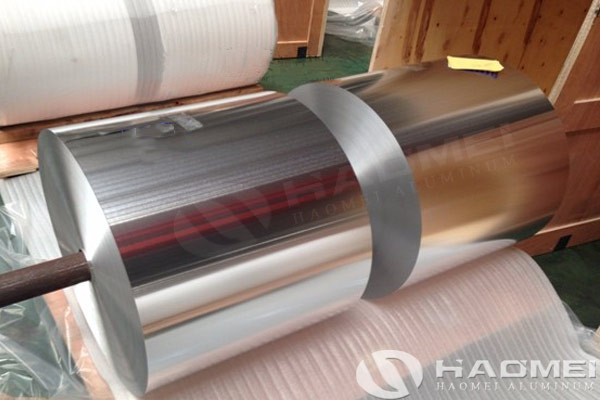
Haomei 8011 household aluminum foil jumbo rolls are supplied in the “O” temper (fully annealed state), offering a balance of excellent flexibility and tear resistance to meet the specific needs of household applications. We offer a thickness range of 10μm to 20μm—including popular specifications like 10μm,, 11μm, 12μm, 14μm, 15μm, and 18μm—suitable for slitting into standard retail-sized rolls. Widths can be customized between 1000mm and 1700mm based on client equipment, with a maximum outer diameter of 1200mm and a net weight of up to 2.5 tons per coil, ensuring seamless compatibility with high-speed, continuous slitting lines. Key performance metrics meet industry-leading standards: for the 15μm specification, the pinhole count is ≤0.2 holes/m² with no through-holes larger than 0.1mm, ensuring a complete barrier against oil and water leakage. The foil offers a stable tensile strength of 85–105 MPa and elongation at break ≥20%, making it resistant to cracking during repeated bending. Produced using a food-grade rolling process, the household aluminum foil roll features a residual oil level of ≤3mg/m², is odorless and free of oil stains, and exhibits heavy metal migration levels far below the limits set by FDA 21 CFR and EU Regulation 1935/2004 for food-contact materials.
For converters, the core value of 8011 aluminum household foil jumbo roll lies in the simultaneous improvement of production efficiency and product yield. The entire coil is produced via continuous rolling from a single billet, eliminating joints entirely and thereby removing waste associated with splices and downtime caused by coil changes. Equipped with an Automatic Gauge Control (AGC) system, the thickness deviation at both the head and tail of the coil is kept within ±2%, while the grammage error of individual slit rolls remains ≤3%; this ensures highly consistent quality for the final small household foil rolls, effectively reducing customer complaints in the end market. Regarding flatness control, a closed-loop adjustment system maintains flatness within 10 I-units; the material exhibits no deviation or edge curling during slitting, and end-face alignment error is ≤0.5mm, ensuring stable compatibility with high-speed slitting equipment operating at 600m/min. I once managed an account for a leading Southeast Asian household foil slitting client; previously, they used standard 1-ton jumbo rolls, requiring six coil changes per shift on a single line with an overall yield of approximately 91%. After switching to our 2.3-ton household foil jumbo rolls, coil changes dropped to twice per shift, the overall yield rose to 96.5%, and daily output per line increased by nearly 30%, effectively controlling hidden costs.
As the core raw material for household foil, 8011 aluminum foil jumbo roll is perfectly suited to end-use scenarios. Its excellent bending toughness and puncture resistance make the slit rolls ideal for various household applications—such as food wrapping, freezing, and oven baking—with a temperature tolerance range of -20°C to 220°C. The dense foil structure provides a complete barrier against light and air, extending food freshness and preventing odor transfer inside the refrigerator.
Backed by a dedicated household foil jumbo roll production line with an annual capacity of 40,000 tons, we offer 15-day delivery for standard specifications; export products feature five-layer vacuum moisture-proof packaging designed for long-haul ocean transport. We can customize hardness, surface tension, and core specifications to match specific client equipment and product positioning, while also providing guidance on slitting process parameters to facilitate rapid production line integration.
