
In the aluminum rolling industry, double-zero aluminum foil is a core benchmark for measuring a company’s process precision, and 8021 aluminium foil is the mainstream choice among double-zero foil products, balancing strength, formability, and cost advantages. As a technician who has followed the double-zero aluminium foil process debugging on the production line for six years, I firmly believe that 8021 double-zero aluminum foil best embodies the industry essence of “material performance is built up through process details”—it doesn’t have the raw material barriers of high-purity aluminum foil, nor does it have the high tolerance for error like thick foil. Every performance improvement is hidden in the fine adjustments of roll roughness, rolling oil viscosity, and tension curves.
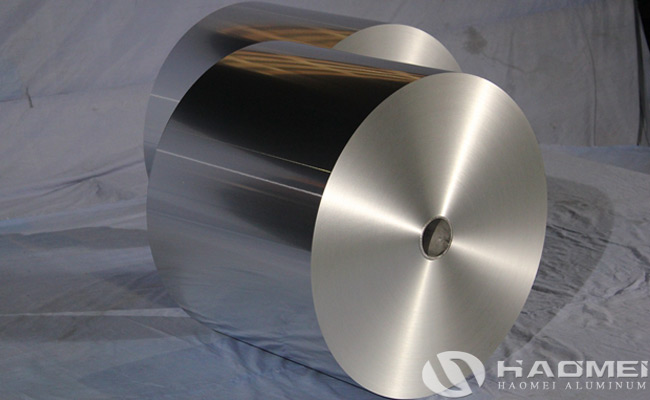
From the perspective of material nature and specification system, 8021 aluminum alloy belongs to the Al-Fe-Si alloy system, with iron and silicon content controlled at 0.6%-1.2% and 0.4%-0.8% respectively. The dispersed precipitated second-phase particles can significantly improve the resistance to deformation under thin specifications, making it one of the few general-purpose alloys that can be stably rolled to a thickness of 6μm. Haomei 8021 aluminum foil covers thicknesses from 6μm to 9μm (commonly known in the industry as double-zero 6 to double-zero 9), with standard widths ranging from 100mm to 1600mm. The maximum roll diameter can reach 1200mm, and the maximum net weight per roll is 2 tons, making it suitable for high-speed slitting and laminating production lines. In terms of core performance, the tensile strength of the O-state finished product is consistently between 70-90MPa, with an elongation after fracture ≥15%. At the same thickness, its strength is more than 15% higher than 1235 high-purity double-zero foil. Pinhole control is a core indicator for double-zero aluminum foil. Through end-to-end cleanliness control, we maintain the pinhole rate of the 6μm specification below 15 pinholes/㎡, with pinhole diameters all less than 0.1mm, far exceeding the industry standard of 30 pinholes/㎡ for superior products. Water vapor transmission rate is <0.5g/(m²·24h), and light blocking rate is close to 100%, fully meeting the moisture-proof and aroma-preserving requirements of food and tobacco packaging.
Process control at the production end is the core factor that differentiates the quality of 8021 double-zero aluminium foil, a point I deeply understood during my early production line debugging. When I first took over the 8021 double-zero foil production line, due to the high alloy content and deformation resistance, the strip breakage rate at a rolling speed of 800m/min was twice that of 1235 aluminum foil, and the yield was less than 80%. Later, our team optimized it from three dimensions: First, we refined the surface roughness of the work rolls from Ra0.03μm to Ra0.018μm, and used food-grade rolling oil with lower viscosity to reduce frictional heat in the rolling deformation zone; second, we optimized the segmented tension control curve, dynamically adjusting the tension deviation according to the rolling pass, reducing the strip breakage rate to 0.3 times/10,000 tons; third, we adopted deep-bed ceramic filtration + two-stage online degassing at the raw material end, controlling the hydrogen content of the aluminum liquid to within 0.1ml/100gAl, reducing pinhole defects from the source. The finished product undergoes a low-temperature, long-time recrystallization process during annealing, ensuring furnace temperature uniformity within ±1℃ and eliminating soft and hard spots across the entire roll, thus guaranteeing stability for subsequent processing.
With its “thin yet non-brittle” characteristics, 8021 double-zero aluminum foil boasts an irreplaceable cost-performance advantage in multiple niche applications.
In the cigarette packaging sector, the 7μm specification is the mainstream substrate for cigarette inner lining paper, offering moisture protection and aroma retention while maintaining moderate stiffness, making it suitable for high-speed packaging machines.
In the food industry, the 6-8μm specification is widely used in twisted packaging for chocolates and candies, exhibiting no springback after twisting and high gloss; our products supplied to several European chocolate manufacturers have passed their zero-pinhole sampling inspection standards.
Furthermore, it is a core barrier layer in milk powder sealing films, pharmaceutical composite packaging, and lithium battery aluminum-plastic films.
Compared to the thicker 8011 aluminum foil, it reduces material usage while maintaining barrier performance, helping customers reduce unit costs.
Currently, the annual production capacity of 8021 double-zero aluminum foil reaches 12,000 tons. Our products have obtained FDA and EU 1935/2004 food contact certifications, and our exports cover more than 30 countries and regions. For ocean shipping scenarios, we use vacuum sealing and multi-layer moisture-proof packaging to prevent oxidation and moisture damage during transportation. We can also adjust the elongation and surface tension according to the customer’s equipment parameters, reducing production line setup costs.
