
Having worked in aluminum foil production and application technology research for many years and encountered the material selection needs of various food container manufacturers, I’ve found a common thread: whether it’s disposable lunch boxes, baking trays, or pre-prepared food containers, 3003-H24 aluminum foil has consistently been the mainstream choice in the industry, rather than other grades. Many clients initially struggle with the low cost of 1000 series pure aluminum foil or the high strength of 3004 aluminum foil, but after in-depth practical experience, most return to 3003-H24 aluminum foil. The core reason is that it achieves a three-dimensional balance of “performance, cost, and safety” in food container manufacturing, a point that other materials cannot easily replace.
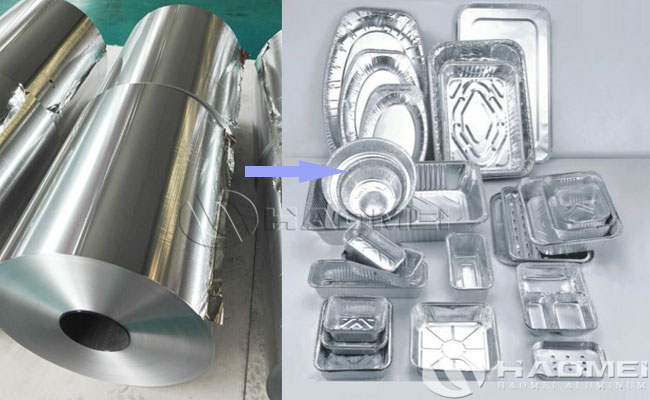
From an alloy perspective, 3003-H24 is an aluminum-manganese alloy, with a manganese content controlled between 1.0% and 1.5%. This ratio is the basis for its suitability for food containers. Unlike pure aluminum foil, which suffers from insufficient strength and susceptibility to deformation, 3003-H24, after work hardening and partial annealing (H24 temper), maintains a tensile strength of 140-170 MPa, a yield strength ≥85 MPa, and an elongation ≥9%. These mechanical properties perfectly match the molding and usage requirements of food containers—possessing sufficient rigidity to withstand the weight of food and stacking pressure, preventing deformation and damage during transportation, while also exhibiting good ductility, allowing for one-time cold stamping of complex shapes, including multi-cavity food containers and irregularly shaped trays. The yield rate can consistently exceed 95%, significantly reducing production costs and waste for enterprises.
The core requirement for food containers is safety, which is the key reason why 3003-H24 aluminum foil for containers is irreplaceable. As a food contact material, it fully complies with the national standard GB 4806.9-2023, with aluminum migration strictly controlled below 5 mg/kg and no toxic or harmful substances leaching out. Its surface naturally forms a dense alumina passivation film 3-5 nanometers thick, effectively resisting corrosion from acidic, alkaline, and salty foods. Even when holding highly corrosive ingredients such as tomato sauce and seafood, it will not degrade or release odors, ensuring food flavor and safety. In contrast, some low-priced alloy aluminum foils, due to excessive impurities, are prone to corrosion and excessive aluminum ion levels with prolonged contact with food, failing food-grade testing.
From a practical economic and functional perspective, 3003-H24 container aluminum foil also has significant advantages. Its cost is lower than high-strength alloy aluminum foils like 3004, and its strength is 10% higher than 1100 series pure aluminum foil. It meets usage requirements without increasing thickness, enabling lightweight production and reducing packaging and transportation costs. Meanwhile, it possesses excellent thermal conductivity, rapidly transferring heat and making it suitable for oven, microwave, and refrigerator heating. This meets the mainstream demand for “instant hot and ready to eat” food containers, and it is 100% recyclable, with recycling energy consumption only 5% of that required for primary aluminum production. This aligns with global environmental trends and the “plastic ban” requirements, helping companies achieve green production transformation.
Many industry peers have asked why not use the stronger 3004 aluminum foil? The truth is, food containers don’t require excessive strength, and the high cost of 3004 would increase the burden on companies. The performance of 3003-H24 aluminium foil perfectly matches the requirements, neither redundant nor insufficient. Years of practical experience have proven that the comprehensive adaptability of 3003-H24 aluminum foil is the core answer for food container manufacturers seeking “stable quality, controllable costs, and safety compliance,” which is also the fundamental reason why it has long maintained its mainstream market position.
