
The core advantage of wrinkle wall aluminum foil containers lies in achieving a leap in structural rigidity with an extremely thin substrate—controllable wrinkles on the sidewalls form mechanical reinforcing ribs, improving the container’s resistance to deformation while reducing material usage. This characteristic is highly dependent on the plastic flow properties and uniform microstructure of the aluminum foil material. As one of the most mass-produced food packaging categories, wrinkle wall containers have specific technical requirements for the aluminum foil’s alloy system, annealing state, and surface precision. Haomei Aluminum’s aluminium foil for wrinkle wall containers is a standardized raw material developed specifically based on the forming mechanism.
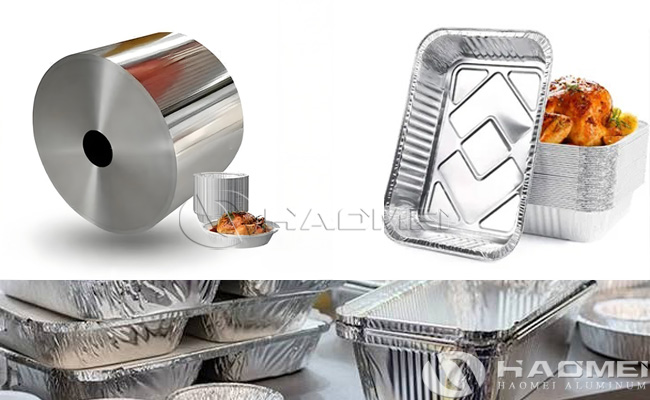
From an alloy selection perspective, 8011-O aluminum foil is the mainstream substrate for wrinkle wall containers globally, and its composition design is perfectly adapted to the corrugation forming mechanism. The iron content in the alloy is controlled at 0.6%~1.0%, and the silicon content at 0.5%~0.9%. The second-phase particles formed by the iron and silicon elements refine the rolled microstructure, improving the aluminum foil’s resistance to pinholes and creating moderate plastic anisotropy. During stamping, the difference in material flow rates in different directions creates uniform and controllable wrinkle accumulation, preventing localized tearing or wrinkle disorder. For deep-cavity, heavy-duty wrinkled-wall containers, 8006 alloy can be selected, as its higher elongation and tensile strength can support a larger draw ratio, resulting in better stiffness after forming. 3003 alloy is mostly used for catering containers requiring high-temperature baking resistance.
In terms of specifications and performance parameters, aluminium foil for wrinkle wall containers forms a clear application classification. For standard takeout containers and lightweight baking trays, a thickness of 0.03mm to 0.08mm is used, with 0.04mm to 0.06mm being the most common specification. Thickness tolerance is strictly controlled within ±8% to ensure consistent roll forming. Heavy-duty baking trays and large-capacity containers use a thickness of 0.09mm to 0.12mm to improve stacking and load-bearing capacity. The material is primarily in a fully soft O-state with an elongation of ≥20%, ensuring sufficient metal flow and uniform, continuous wrinkle texture during stamping. The pinhole diameter is ≤0.1mm, and the number of pinholes per unit area is far below the industry threshold, eliminating leakage risks at the source.
Uniform structure and controllable plasticity allow aluminium foil for wrinkle wall containers to be adapted to high-speed stamping production lines of 60-80 strokes per minute, nearly doubling production efficiency compared to smooth-walled containers. Stable material properties keep the forming scrap rate within the 2%-4% range, reducing waste. Our aluminium foil for food container products can be equipped with either light or standard oiling processes, with an oil film coverage of 10-25 mg/m². This reduces mold friction, improves molding smoothness, and prevents oil residue from affecting food contact safety. All oils comply with FDA and EU 10/2011 food contact standards.
As a professional aluminum foil supplier, Haomei Aluminum can adjust alloy composition deviations and annealing hardness according to customer mold parameters and container shapes, adapting to the wrinkle depth and density requirements of different manufacturers. Roll widths can be customized from 30mm to 650mm, and roll weight and core inner diameter can be matched to production lines as needed. Export products use moisture-proof and waterproof packaging suitable for ocean shipping. Leveraging our large-scale production capacity and USD pricing system, we provide stable supply and technical support to global food packaging manufacturers, helping customers reduce costs and increase efficiency from the material perspective.
