
In the mass production of semi-rigid aluminum foil containers for food, aluminum foil surface friction, stamping cracking, and finished product adhesion have always been core pain points restricting production yield. Lubricated container aluminum foil, through a high-precision quantitative rolling oil coating process, specifically solves various forming and processing problems. It is currently the mainstream substrate for high-end takeaway food boxes, baking trays, airline catering, and fresh food preservation containers, and is also the standardized aluminum foil product that Haomei Aluminum promotes to packaging manufacturers worldwide.
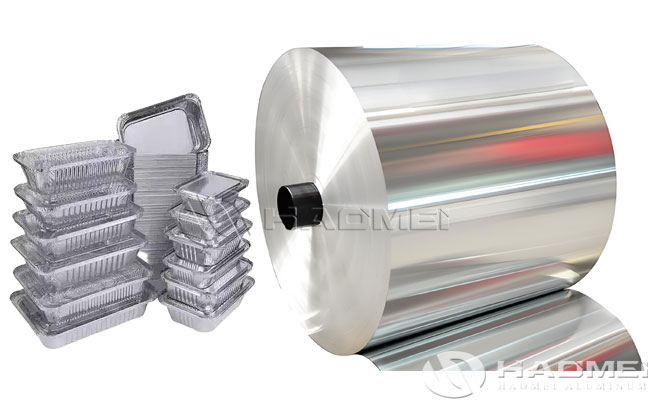
This lubricated aluminum foil for semi rigid container substrate can be selected from three mainstream alloys: 3003, 3004, and 8011. It also supports two mechanical states: O-state soft material and H24 semi-rigid material. The thickness ranges from 0.035mm to 0.20mm, and it is suitable for all types of semi-rigid container forming processes, including shallow stamping, deep drawing, folding, and crimping. During the production stage, food-grade special rolling lubricating oil is used, coupled with automated single/double-sided uniform oiling equipment to precisely control the oil film adhesion on the board surface. It is generally divided into two specifications: light oiling and standard oiling. The oil film amount is consistently maintained at 10–30 mg/㎡, with no localized oil accumulation or large areas of oil-free blanks on the entire roll. The uniformity of the oil layer distribution far exceeds that of ordinary coarsely oiled aluminum foil in the industry.
Food safety is an insurmountable hard indicator for lubricated container aluminum foil. All the lubricating oils we use in our entire line comply with EU 10/2011 and US FDA food contact standards, and are free of aromatic hydrocarbons, heavy metals, and other harmful impurities. Even after high-temperature baking at 230℃ and long-term contact with tomato juice, vinegar-based acidic sauces, and animal and vegetable oils, no odor or harmful substances will be released. The formed containers can be used directly for food without washing, and are suitable for use in refrigeration, ovens, and microwaves. Aluminum foil substrate itself possesses complete airtight barrier properties, isolating moisture, oxygen, and ultraviolet rays. Combined with a uniform oil film, this further enhances the surface’s oxidation resistance, making it less prone to oxidation spots and blackening defects during long-distance ocean shipping and storage.
The uniform and controllable oiling process brings multiple tangible production advantages to aluminum container foil stamping. During high-speed stamping, the uniform oil film forms a stable lubricating layer, reducing dry friction between the aluminum foil and the steel die, significantly reducing defects such as tearing, scratches, and abrasions, improving the overall stamping yield by 8%–15%. High-speed slitting of coils is less prone to sticking to the blade and fraying, perfectly adapting to automated high-speed continuous production lines. When finished containers are stacked, the surface oil film prevents direct foil adhesion, ensuring smooth demolding without additional powdering, eliminating the need for subsequent cleaning and dust removal processes, and reducing customer processing costs. Simultaneously, the thin and uniform oil layer does not hinder secondary processing such as anti-stick coating, color printing, and heat sealing lamination, allowing customers to achieve diverse surface customizations as needed.
In terms of end-to-end quality control, Haomei Aluminum monitors three core indicators in real time: oil film thickness, pinholes on the board surface, and thickness tolerance. Thickness tolerance is strictly controlled within ±0.001mm, and the number of pinholes is far below the industry average threshold, eliminating the risk of container leakage at the source. The effective width of the roll material is 30–680mm and can be cut as needed. Roll weight and core inner hole dimensions can also be customized. Exported finished products are double-sealed with moisture-proof kraft paper and a waterproof film to resist the high humidity and salt spray environment at sea, ensuring stable quality during long-distance transportation.
Compared to conventional oil-free aluminum foil, oil lubricated aluminum foil has lower processing loss and stronger forming stability. Cheap, excessively oil lubricated aluminum foil on the market is prone to oil stains contaminating the finished product and ink smudging during printing. Our factory’s precise oil control process perfectly avoids this defect, balancing lubrication effect and board surface cleanliness. Leveraging multiple large-scale integrated cold rolling, annealing, and oiling production lines, we can provide stable, high-volume supply. Our pricing is synchronized with international aluminum ingot market trends in real time, and we provide complete export customs documentation. Our professional technical team can adjust the oil film coating amount according to the customer’s stamping equipment and container style, offering customized solutions tailored to individual needs.
Semi-rigid container lubricated aluminum foil balances processing performance, food safety, and overall production costs, making it an ideal substrate for automated food packaging production lines. Haomei Aluminum, with its mature and controllable precision oiling process and stringent closed-loop quality control standards, continuously supplies high-stability, cost-effective aluminum foil raw materials to global food packaging companies.
