
Aluminum foil food tray is widely used in fresh food cold chain, pre-prepared food packaging, airline catering, and supermarket ready-to-eat display. Compared to conventional food containers, it has a larger surface area and more complex load-bearing conditions, placing more specific demands on the substrate’s stiffness, flatness, barrier stability, and forming consistency. Haomei Aluminum’s aluminium foil for food tray is specifically optimized in terms of material formulation and rolling process to meet the needs of large-size shallow-drilling and multi-scenario use, providing stable and reliable substrate solutions for global food packaging and cold chain companies.
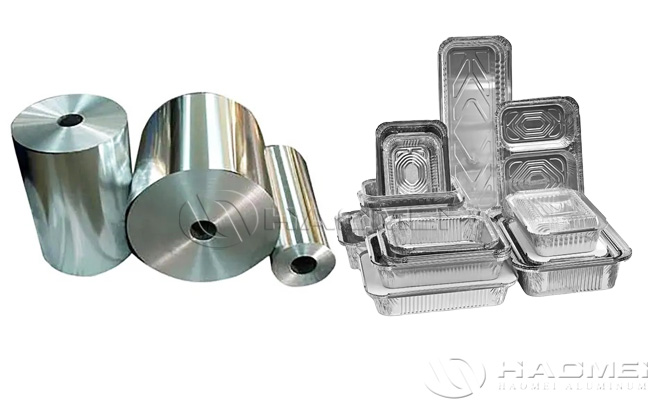
From an alloy system selection perspective, aluminium foil for food tray making follows a “scenario matching” core logic, forming a tiered product matrix.
8011 O is the mainstream economical grade. By optimizing the iron-silicon ratio (iron 0.6%–1.0%, silicon 0.5%–0.9%), it improves the density of the board surface while ensuring shallow-punching performance. It is suitable for regular fresh fruit and vegetable trays and disposable snack display trays, offering high production efficiency and controllable costs, making it the first choice for high-volume orders.
For scenarios requiring high temperature resistance and high load-bearing capacity, such as pre-prepared food heating trays and heavy-duty fresh meat trays, 3003-O or 3003 H24 aluminum foil is used. The strength gain and corrosion resistance provided by manganese allow the trays to remain uncollapsed under 180℃ baking and undeformed during cold chain stacking.
The higher-specification 8006 alloy is suitable for deep-cavity thickened trays, meeting the heavy-duty requirements of cooked food and baked goods.
Regarding specifications and quality control standards, the aluminium foil for food tray has been specifically optimized for large-size forming. The product thickness ranges from 0.04mm to 0.18mm, with the 0.04-0.07mm thinner material used for lightweight fruit and vegetable/snack trays, achieving material weight reduction; 0.08-0.12mm is the main specification, accounting for over 65% of the total market application, suitable for standard fresh food trays and pre-prepared vegetable base trays; the 0.13-0.18mm thicker material is mainly used for heavy-duty baking and cooked food trays, providing stronger support. Roll widths can be customized from 100mm to 800mm, adapting to various large-size tray molds; thickness tolerance is strictly controlled within ±0.001mm, and flatness ≤10I, ensuring uniform stress distribution during large-area stamping and eliminating defects such as wrinkles, warping, and uneven corners. Pinhole control adheres to even higher standards, with the number of pinholes larger than 0.1mm per square meter controlled to single digits, preventing leakage of fresh food blood and broth from the source.
For diverse usage scenarios, aluminum foil for food tray offers the advantage of adaptability to all working conditions. With a temperature resistance range of -40℃ to 220℃, the material remains brittle even under rapid freezing and cold chain conditions. No harmful substances are released during oven or steam heating. All products have passed FDA and EU 10/2011 food contact safety certifications, allowing direct contact with acidic and oily foods. Aluminum foil’s natural barrier properties isolate oxygen, moisture, and odors, extending the shelf life of fresh produce by over 30%. Surface finishes can be customized to glossy or matte. Glossy finishes enhance the visual appeal of supermarket displays, while matte finishes are suitable for non-stick and hydrophilic coatings. A lightweight oiling process ensures a stable oil film level of 8–22 mg/㎡, balancing stamping lubrication with food contact surface cleanliness, eliminating the need for additional cleaning after forming.
As a professional aluminum foil exporter, Haomei Aluminum possesses wide-width precision rolling capabilities, enabling the production of large-roll products and reducing roll changeover frequency for customers. We can tailor alloy hardness and surface treatments to specific pallet sizes, forming depths, and application scenarios, providing customized material selection solutions. Large-scale production capacity ensures stable delivery of large orders; dollar-denominated pricing is linked to international aluminum ingot prices; export products are packaged with moisture-proof and rust-proof materials suitable for ocean shipping; and a full set of compliant documents and comprehensive technical support are provided to help customers efficiently implement pallet production projects.
