
In building waterproofing systems, aging and cracking of roofing membranes, insufficient thermal insulation, and waterproofing failure remain common pain points for building material customers worldwide. As supplier specializing in aluminum foil development for building materials, Haomei Aluminum have developed the 8011 aluminum foil for the composite needs of modified bitumen and self-adhesive waterproofing roofing membranes. This is not simply a cross-industry application of ordinary packaging aluminum foil, but a functional material with a complete process from alloy selection and surface treatment to sheet shape control. It fundamentally solves three major industry challenges for roofing membranes: UV degradation, thermal expansion and contraction fatigue, and moisture penetration. Currently, it is being exported to waterproofing membrane manufacturers in over 20 countries worldwide.
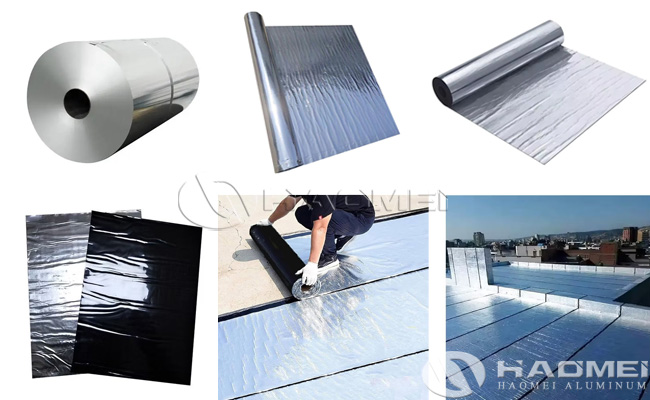
Haomei 8011 aluminum foil for roofing membrane is supplied in the O soft temper as the standard supply state, balancing roll-pressed composite adhesion with on-site bending toughness. The thickness ranges from 0.02mm to 0.12mm, with 0.03mm and 0.05mm being the mainstream selections in the industry. The width is fully compatible with mainstream global roll production lines, with 1000mm, 1220mm, and 1250mm specifications readily available, and can be customized up to 1600mm. We support the supply of large-diameter master rolls, with a maximum single roll weight of 2.5 tons, which can reduce downtime losses for customers when changing rolls. Core performance indicators are optimized specifically for outdoor building material scenarios: visible and near-infrared solar reflectance ≥86%, normal thermal emissivity ≥0.87; peel strength to modified asphalt substrate ≥1.6 N/mm, adhesion retention rate ≥85% after 72 hours of heat aging at 100℃; pinhole rate strictly controlled below 0.2 pins/㎡, achieving complete water impermeability; after 1500 hours of QUV accelerated aging test, the surface shows no powdering or cracking, and reflectance attenuation is less than 5%.
Unlike general-purpose aluminum foil, the core competitiveness of 8011 aluminum foil for roofing insulation lies in its specialized process optimization for composite processes and outdoor conditions. We employ a single-textured rolling process, with the composite side undergoing uniform micro-texturing treatment. This significantly enhances the adhesion to asphalt and adhesive layers through mechanical interlocking, preventing delamination and blistering issues during high-temperature construction and long-term use. The surface undergoes chromium-free passivation treatment, improving corrosion resistance in humid and salt spray environments while meeting EU RoHS environmental requirements, making it suitable for roofing conditions in coastal and high-humidity areas. The entire rolling process utilizes a low-residual-oil control technique, with surface residual oil content ≤3mg/㎡, eliminating bubbles and poor adhesion defects at the source during the lamination process. Simultaneously, through AGC automatic thickness control and closed-loop sheet shape adjustment, the straightness of the wide foil is controlled within 10I units, ensuring a wrinkle-free and deviation-free continuous lamination production line for the roll material, increasing the customer’s production line yield to over 98%.
When laminated into a waterproof roll material system, this 8011 aluminum foil achieves a triple upgrade in waterproofing, heat insulation, and weather resistance, bringing significant engineering value.
In high-temperature summer environments, the high-reflectivity surface layer can reduce roof surface temperature by 15-25°C, reducing air conditioning energy consumption on the building’s top floor by 15%-20%. It also significantly alleviates thermal expansion and contraction fatigue caused by diurnal temperature variations in the roofing membrane, reducing the risk of cracking and leakage at the source.
The dense aluminum foil layer completely blocks ultraviolet rays and liquid water, protecting the underlying asphalt substrate from photo-oxidative degradation, extending the service life of ordinary modified asphalt roofing membranes from 5-7 years to over 15 years.
Furthermore, the mechanical properties of the aluminum foil itself enhance the overall tear and puncture resistance of the membrane, reducing the probability of damage during construction and subsequent maintenance.
Currently, the aluminum foil is widely compatible with SBS/APP modified asphalt roofing membranes, self-adhesive waterproofing membranes, and polymer composite membranes, and is extensively used in industrial plants, logistics warehouses, photovoltaic roofs, and residential roofs, especially suitable for the building needs of high-temperature, high-UV regions such as the Middle East, Southeast Asia, and Latin America.
Leveraging our annual production capacity of 30,000 tons of aluminum foil for building materials, we can deliver standard specifications within 15 days. We also offer customized solutions based on customer roll formulations, lamination processes, and local climates. For export customers, we use five-layer vacuum moisture-proof packaging suitable for ocean shipping and provide technical support for adjusting lamination process parameters, helping customers quickly adapt their production lines.
