
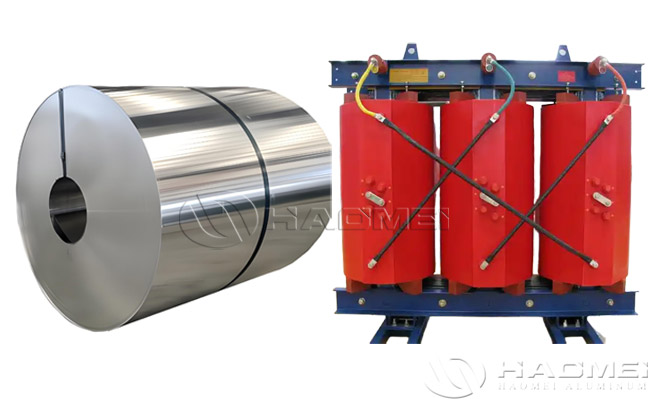
Using aluminum foil as a conductor material in transformer windings is a rational choice in the power equipment manufacturing industry, based on a comprehensive optimization of performance, cost, and process. It is particularly widely used in medium and low-voltage distribution transformers and special transformers. As a technician at Haomei Aluminum specializing in transformer aluminum foil production, I will analyze the core reasons why aluminum foil has become an ideal winding material from four dimensions: electrical performance, mechanical structure, manufacturing process, and total life cycle cost, combined with specific technical parameters and production practice.
I. Balancing Electrical Performance: Optimizing the Choice Between Conductivity and Skin Effect
Pure aluminum (1050/1060/1070 series) foil has a conductivity approximately 61% that of copper (37 MS/m vs 61 MS/m). However, through reasonable cross-sectional design (aluminum cross-section is 1.64 times that of copper), equivalent DC resistance can be achieved, meeting the requirements for the same level of loss. More importantly, the flat structure of aluminum foil perfectly adapts to the skin effect under AC operating conditions—when the frequency is ≥50Hz, the current mainly concentrates within a 0.3mm depth of the conductor surface. Aluminum foil with a thickness precisely controlled between 0.1 and 0.3mm can increase conductor utilization to over 95%, far exceeding that of round wire windings (approximately 75%). Haomei’s transformer aluminum foil, through an online continuous annealing process, stably controls the material conductivity at 35~37 MS/m, while reducing eddy current losses by 30%~40%, ensuring equivalent load loss performance to copper foil windings in 100kVA~2500kVA transformers.
II. Mechanical Structural Advantages: Comprehensive Improvement from Short-Circuit Resistance to Heat Dissipation Efficiency
The integral rigid structure formed by foil windings provides 3~5 times the short-circuit current resistance of traditional round wire windings. When subjected to a 25kA short-circuit current impact, the axial and radial mechanical stress distribution of the aluminum foil winding is more uniform, and the coil deformation is controlled within 0.5mm, far below the national standard limit (2mm). In terms of heat dissipation performance, the flat shape of the aluminum foil increases the heat dissipation area by 400% compared to a round wire of the same cross-sectional area. Combined with 0.5mm of interlayer insulation paper and ventilation channel design, the hot spot temperature of the winding can be reduced by 8~12℃, significantly extending the insulation life (the insulation life doubles for every 10℃ decrease in temperature). Haomei’s 3003 aluminum-manganese alloy foil, by adding 0.15%~0.35% manganese, increases the tensile strength of the material to 120~150MPa while maintaining an elongation of over 18%, ensuring structural stability while meeting the bending and welding requirements during winding processing.
III. Manufacturing Process Innovation: Guarantee of Automated Production and Quality Consistency
The continuous winding process of aluminum foil windings has completely changed the traditional coil manufacturing mode. Haomei offers customizable aluminum foil widths (30mm~1200mm) to accommodate transformers of varying capacities. Combined with automated foil winding machines, it achieves winding speeds of 120-150 meters per hour, increasing production efficiency by four times and avoiding common issues like inter-turn gaps and uneven arrangement found in round wire winding. For welding, argon arc welding or laser welding is used to connect the aluminum foil ends to the copper-aluminum transition busbars, with joint resistance controlled below 5μΩ, meeting GB1094.1 standards. In terms of surface treatment, the naturally formed 2-5μm dense alumina film (Al₂O₃) on the aluminum foil boasts a breakdown voltage of 300V/μm, providing additional insulation protection for the windings—a natural advantage unmatched by copper.
IV. Life Cycle Value: Dual Benefits of Cost and Environmental Protection
Aluminum’s density is only 30% of copper’s (2.7g/cm³ vs 8.96g/cm³). Using aluminum foil windings in transformers of the same capacity can reduce weight by 40%~50%, lower transportation costs by 35%, and simultaneously reduce installation difficulty and foundation load requirements. In terms of raw material costs, aluminum is about one-third the price of copper. Combined with improved processing efficiency, overall manufacturing costs are reduced by 25%~30%. Furthermore, through optimized design (such as increasing the core cross-sectional area and using high-permeability silicon steel sheets), an energy efficiency level equivalent to copper windings can be achieved (reaching GB20052-2024 Level 2 energy efficiency). From an environmental perspective, aluminum’s recycling rate reaches 98%, far exceeding copper (approximately 85%), and the energy consumption of recycled aluminum is only 5% of that of primary aluminum, aligning with the global trend towards low-carbon development in the transformer industry.
In summary, the selection of aluminum foil for transformer windings is a result of a balance between technology and economics, rather than a simple cost compromise. As a professional aluminum foil manufacturer, Haomei Aluminum provides customized aluminum foil solutions to over 300 transformer companies worldwide through optimized material formulations and precise rolling and heat treatment process control. Its products are applied in power grid upgrades, data centers, and new energy power plants, ensuring performance while driving the transformer industry towards lightweight, high-efficiency, and green manufacturing.
