
Aluminium foil, with its unique material properties and processing advantages, is an ideal substrate for semi-rigid containers, possessing three core advantages: formability, barrier properties and safety. Aluminum foil has excellent ductility, allowing it to be manufactured into various shapes of semi-rigid containers through stamping, deep drawing, and other processes, maintaining structural stability after molding; its complete barrier properties effectively block oxygen, moisture, light, and odors, extending the shelf life of the contents; it is also food-grade safe, meeting international standards such as FDA and EU, allowing direct contact with food, and is resistant to high and low temperatures (-20℃ to 250℃), suitable for refrigerator refrigeration, oven heating, and microwave use. Furthermore, aluminum foil is lightweight (density only 2.7g/cm³), reducing transportation costs, and is 100% recyclable, with recycling energy consumption only 5% of that required for primary aluminum production, aligning with environmental trends.
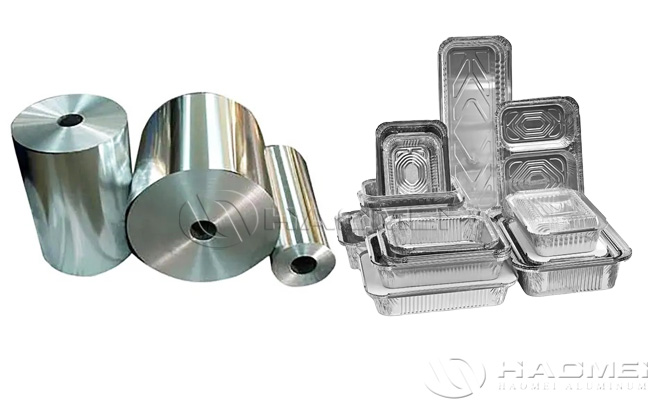
The alloys and specifications of semi rigid container aluminum foil need to balance formability, strength, and cost. The mainstream choices are concentrated in the 3000 and 8000 series, with thickness precisely matched to the container type.
– 3004-O aluminum foil (Al-Mn-Mg system):
Manganese 1.0%-1.5%, Magnesium 0.8%-1.3%, higher strength than 3003, excellent ductility, suitable for complex containers formed by deep drawing, such as lunch boxes and baking trays, the first choice for high-end semi-rigid containers.
– 3003-O aluminum foil (Al-Mn system):
Manganese 1.0%-1.5%, moderate cost, good formability and corrosion resistance, used for shallow-drawn containers such as food trays.
– 8011-O aluminum foil (Al-Fe-Si system):
Iron 0.6%-1.0%, Silicon 0.5%-0.9%, economical price, suitable for simple disposable containers, such as cake trays and foil bowls.
– Thickness:
0.03mm-0.2mm, thinner specifications (0.03-0.08mm) are for small disposable containers, thicker specifications (0.1-0.2mm) are for food containers and baking utensils requiring strength.
– Width:
30-600mm, adaptable to different container sizes; all are in O-state (fully annealed) to ensure optimal formability.
– Surface Treatment:
Food-grade uncoated or single-sided coated, enhancing non-stick and sealing performance.
The container aluminum foil boasts multiple practical advantages from a raw material perspective, perfectly meeting the needs of container manufacturing and processing.
Firstly, it exhibits superior plasticity and molding properties, with a uniform, fully soft O-state structure, minimal tensile springback, and a high yield rate in mass production, significantly reducing production losses.
Secondly, the material is pure with minimal pinholes, thanks to excellent smelting and rolling processes, resulting in a dense, sand-free surface that eliminates leakage issues from the raw material stage.
Thirdly, it offers stable corrosion and temperature resistance, strong oxidation resistance, and resists oxidation and discoloration even during long-term storage, maintaining stable material performance under both hot and cold environments.
Fourthly, it features high surface flatness and precision, with strict thickness tolerance control. The material exhibits uniform hardness and softness throughout the roll, ensuring excellent consistency in batch stamping production.
Fifthly, it offers strong surface treatment adaptability. The clean, oil-free surface allows for direct secondary processing such as printing, lamination, and coating, maximizing processing compatibility.
Sixthly, its lightweight and easy-to-cut texture ensures burr-free and chip-free cutting, making it suitable for automated high-speed production lines and effectively improving customer production efficiency.
As a professional aluminum foil manufacturer and exporter, Haomei Aluminum possesses a complete supply chain advantage in the semi-rigid container aluminum foil field, from material research and development to global delivery.
– Materials R&D and Quality Control:
Independently developed special alloys for container foil, including 3004, 3003, and 8011, with strict control over composition deviations (manganese ±0.05%, magnesium ±0.03%) to ensure consistent forming. Products are certified by international standards such as ISO9001, ISO14001, FDA, and DNV, with no roller marks, pinholes, or corrosion on the surface, meeting the highest food-grade standards.
– Precise Specification Customization:
Offers a full thickness range of 0.03-0.2mm, with widths customizable to customer requirements (minimum 30mm). Supports customized coatings and surface treatments to adapt to different forming processes.
– Cost and Delivery Advantages:
Large-scale production reduces costs by 10%-15%. Real-time linkage with aluminum ingot prices (approximately USD 2800-3000/ton in May 2026) ensures transparent pricing. Equipped with 10 high-speed slitting lines, regular orders are delivered within 7 days. Export coverage extends to over 160 countries, with flexible logistics solutions including sea and air freight.
– Technical Support and Service:
A professional team provides guidance on forming processes, solving technical challenges in stamping and deep drawing; concierge-style service covers pre-sales consultation to after-sales follow-up, ensuring full order control.
Aluminum foil, with its formability, barrier properties, safety, and environmental friendliness, has become the preferred material for semi-rigid containers. 3004, 3003, and 8011-O alloys (0.03-0.2mm) are the mainstream choices. Haomei Aluminum provides optimal solutions for semi-rigid container aluminum foil to global customers through customized materials, stringent quality control, cost advantages, and full-chain services, contributing to the upgrading and sustainable development of food packaging.
