
Electronic aluminum foil serves as the core electrode material for aluminum electrolytic capacitors, performing the critical functions of forming the dielectric oxide layer and providing the necessary electrode surface area. Based on their roles within the capacitor, electronic aluminum foil for capacitor are categorized into two main types: anode foil and cathode foil. Anode foil undergoes electrochemical etching and forming processes to create a porous structure and an Al₂O₃ dielectric film; these processes directly determine the capacitor’s capacitance and voltage rating. Cathode foil undergoes etching to increase its effective surface area, primarily influencing the capacitor’s equivalent series resistance (ESR) and high-frequency characteristics.
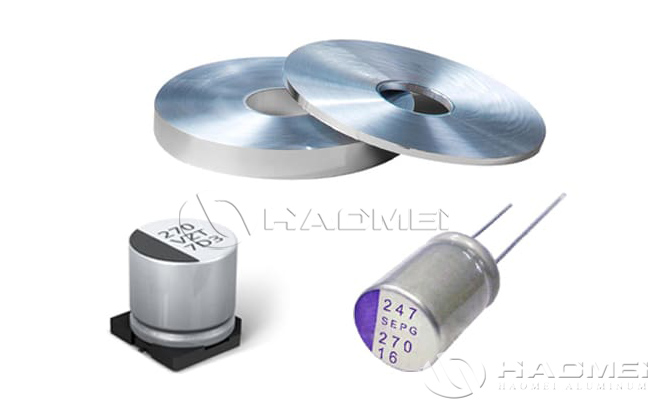
Haomei electronic aluminum foil product line covers the following mainstream specifications:
– Alloy Grades: 1A99 (purity ≥99.99%), 1A95 (≥99.95%), and 1235 (≥99.35%); selected based on the capacitor’s voltage rating and application scenario.
– Thickness Range: Anode foil 0.080 mm–0.120 mm; cathode foil 0.060 mm–0.100 mm.
– Common Specifications: 0.100 mm anode foil and 0.080 mm cathode foil are standard industry sizes.
– Width Range: 200 mm–600 mm; customizable according to the roll diameter of the customer’s etching production line.
– Delivery Condition: O-temper (fully annealed/soft); tensile strength 60–80 MPa; elongation at break ≥18%.
– Thickness Tolerance: Within ±2%.
– Surface Roughness (Ra): 0.20–0.35 μm; optimized for the etching/pore-formation process.
– Pinhole Rate: ≤0.1 holes/m².
– Surface Residual Oil: ≤2 mg/m².
Through years of providing technical services, I have found that the three most common issues faced by capacitor customers—high capacitance variance, excessive leakage current, and short service life—can often be traced back to the quality of the electronic aluminum foil substrate.
– Purity determines etching uniformity.
Segregation of impurity elements such as Fe, Si, and Cu in the molten aluminum creates localized electrochemical active sites during etching, leading to uneven etch-pit density and capacitance deviations exceeding 10% within a single batch. By employing an eccentric-bottom melting and casting process combined with three-stage ceramic filtration, we keep the total Fe+Si content below 0.015% and impurity particle sizes at or below 10μm, thereby narrowing the batch-to-batch specific capacitance deviation to within ±4%.
– Surface condition determines the quality of etch initiation.
Surface roughness directly affects the distribution density of etch initiation sites. Excessive roughness (Ra) leads to coarse etch pits and an increased risk of perforation, while insufficient roughness results in low etch-pit density and reduced capacitance. We precisely control the Ra value within the 0.25–0.30μm range to match mainstream electrochemical etching systems, allowing customers to feed the material directly into production lines without additional surface pretreatment.
– Strip shape precision determines production continuity and stability.
Electronic aluminum foil travels continuously through etching and formation lines at speeds of 20–30 m/min; poor strip shape can cause tracking deviations, wrinkling, or even strip breakage. We control flatness to within 8 I-units and limit thickness variation across the entire coil (head, middle, and tail) to ≤1.5%, ensuring uninterrupted continuous production for our customers.
We offer a comprehensive range of capacitor aluminum foil grades—from 1235 to 1A99—meeting the requirements for the full spectrum of capacitors, from low-voltage to high-voltage applications. We can tailor grain orientation and surface conditions to align with specific customer etching formulas and formation processes. With an annual production capacity of 5,000 tons and standard specifications kept in stock, we offer a lead time of 15–20 days; our products are fully compliant with REACH and RoHS standards.
Haomei electronic aluminum foils are widely used in the manufacture of aluminum electrolytic capacitors for applications such as industrial control power supplies, electronic control systems for new energy vehicles, photovoltaic inverters, home appliance motherboards, and telecommunications power supplies. Please contact us for detailed information, including samples for testing or technical datasheets.
