
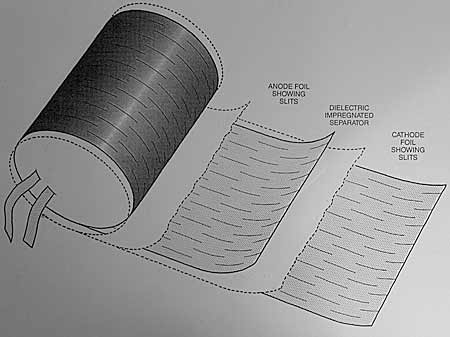
Among electronic grade aluminum foil products, capacitor aluminum foil is one of the most demanding segments of the aluminum foil industry regarding raw material purity and surface consistency. Processes such as anodic etching and formation (for anodes) and the creation of oxide films (for cathodes) in electrolytic capacitors rely directly on the surface purity and grain uniformity of the aluminum foil; any trace impurity segregation or surface defect can lead to excessive leakage current and reduced capacitor lifespan. Haomei 1235 aluminum foil for electrolytic capacitor applications, is designed around these core requirements from raw material control to final product inspection—and is currently supplied to dozens of capacitor manufacturers worldwide.
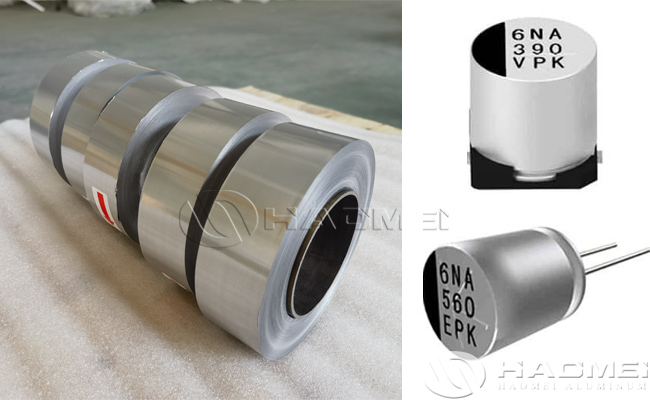
Based on high-purity aluminum (≥99.35%), the 1235 alloy features a controlled composition with a combined iron and silicon impurity content of less than 0.65% and a copper content of ≤0.05%. This chemical composition ensures a uniform distribution of etch pits and stable specific surface area enhancement during subsequent electrochemical etching processes. Our capacitor aluminum foil is available in thicknesses ranging from 0.06 mm to 0.11 mm—with 0.08 mm and 0.10 mm being the industry-standard specifications—and widths customized to customer etching line requirements (between 200 mm and 600 mm). Master coils weigh up to 1.2 tons, making them suitable for continuous etching and formation production lines.
In terms of performance, 1235 aluminum foil is delivered in a fully annealed (O-temper) state, with a tensile strength of 55–75 MPa and elongation at break of ≥18%. Hardness is highly consistent, with a Vickers hardness deviation of ≤5 HV across the entire coil. Surface roughness (Ra) is controlled between 0.25 μm and 0.35 μm, ensuring uniform distribution of etching initiation points while preventing excessive roughness that could lead to oversized etch pits. The pinhole count is ≤0.1 per m², eliminating short-circuit risks during capacitor manufacturing, and residual surface oil is ≤2 mg/m², ensuring no oil contamination interferes with the wetting of the etching solution.
Differences in the quality of electronic-grade aluminum foil often stem from the precision with which raw materials and rolling details are controlled. Years ago, while working with a Southeast Asian capacitor manufacturer, I encountered an issue where post-etching capacitance varied excessively; tracing the root cause revealed that fluctuations in trace element segregation within the original supplier’s aluminum foil were causing uneven etching-pit density. We subsequently implemented targeted optimizations across three dimensions: Regarding raw materials, we utilized high-purity molten aluminum combined with three-stage ceramic filtration to keep inclusion sizes below 10μm, while strictly controlling fluctuations in trace impurities such as zinc and magnesium. In the rolling process, we optimized the distribution of reduction rates per pass to prevent grain coarsening or abnormal deformation textures, ensuring consistent dissolution rates across crystal planes during etching. And for annealing, we employed vacuum furnaces to eliminate residual rolling stresses while controlling the oxygen content of the atmosphere to prevent abnormal thickening of the surface oxide layer. After nearly six months of process iteration, the batch-to-batch deviation in post-etching specific capacitance narrowed from the industry standard of ±8% to ±4%, and the client remains a stable partner to this day.
Compared to general-purpose 1235 packaging aluminum foil, electrolytic capacitor aluminum foil offers distinct advantages in three areas. First, purity and impurity controls are more rigorous; trace elements such as zinc, magnesium, and copper are individually regulated to prevent abnormal localized electrochemical reactions during etching. Second, the surface characteristics are better suited for electrochemical processing; surface roughness and residual oil levels are precisely calibrated, allowing customers to proceed directly to etching without additional pretreatment. Third, batch consistency is superior, with performance variance between the beginning, middle, and end of a coil kept within 3%, and the pass rate for finished capacitor leakage current consistently exceeding 99.5%.
Supported by a dedicated production line for electronic-grade aluminum foil with an annual capacity of 5,000 tons, Haomei 1235 aluminum foil for electrolytic capacitors are REACH and RoHS certified, and we offer collaborative tuning of etching process parameters with our clients. All export products feature vacuum-sealed, moisture-proof packaging, ensuring surfaces remain free from oxidation and contamination during transit and are ready for immediate use upon arrival.
