
What is non-lubricated aluminum foil for containers? Simply put, it’s a specialized aluminum foil that requires no additional food-grade oiling agent and can be directly used for stamping food containers. It uses 8011-H22 and 3003-H24 aluminum alloys as the base material, processed through precision casting, cold rolling, and annealing, leaving no oil residue and achieving a Class 1000 surface cleanliness level. Non lubricated aluminium foil product is specifically designed for direct food contact applications, eliminating the need for downstream customers to perform degreasing processes. It can be directly adapted for stamping various containers such as disposable lunch boxes and baking trays, combining safety, hygiene, stable forming, and excellent barrier properties, and is widely used in catering and food packaging industries.
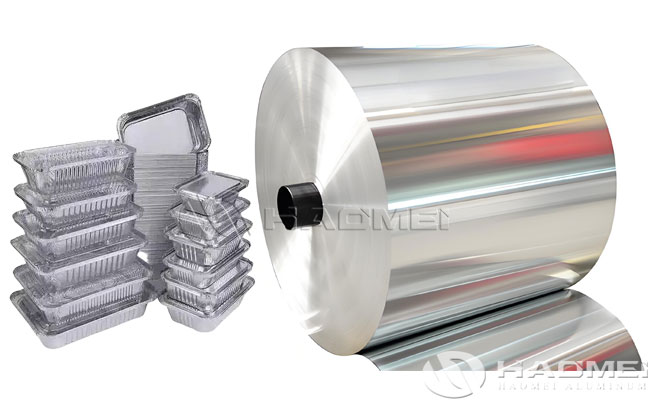
The core positioning of non lubricated container aluminum foil is “oil-free and clean, safe and adaptable, and stable in molding.” Primarily designed for direct food contact scenarios, it eliminates the need for additional degreasing treatment, significantly reducing production processes and costs for downstream customers. This is its core advantage over lubricated aluminum foil and a key technological focus that Haomei has been working on in its production. To meet export market demands, our non lubricated aluminum foil for containers are all processed from virgin aluminum ingots, with core materials selected from 8011-H22 and 3003-H24 aluminum alloys. Specifications range from 0.03mm to 0.20mm, and widths can be customized to customer requirements (300mm to 1600mm). They are perfectly suited for stamping processes of various containers such as disposable lunch boxes, baking trays, food storage containers, and food trays.
From a production technology perspective, the core challenge of non lubricated aluminum foil for containers lies in resolving three major industry pain points: adhesion during forming, edge burrs, and insufficient cleanliness, all while maintaining an oil-free environment. This is also the core competitive advantage of Haomei uncoated aluminum foil. Regarding raw material control, we select virgin aluminum ingots with a purity of ≥99.7%, eliminating raw materials with impurities containing ≥0.01% to prevent surface defects caused by impurities from the source. In the casting and rolling process, we control the casting and rolling temperature at 680±5℃ and the rolling speed at 2.8~3.2m/min to ensure uniform grain size of the aluminum foil substrate, with a grain size controlled at 8~12μm, providing a foundation for subsequent oil-free forming.
Cold rolling and annealing processes are key to the quality control of non lubricated aluminum foil. We employ a multi-pass cold rolling process, controlling the reduction rate of each pass to 18%~22% to avoid wrinkling and uneven thickness of the aluminum foil surface caused by excessive single-pass reduction. In the annealing stage, we use segmented vacuum annealing, controlling the temperature at 380~420℃ and holding it at that temperature for 2~3 hours. This eliminates internal stress generated during cold rolling, improves the ductility of the aluminum foil (elongation ≥35%), and ensures that the aluminum foil surface is free of oxidation and oil residue, achieving a cleanliness level of Class 1000 with no oil residue ≤5mg/m², far exceeding the requirements of EU 10/2011 and US FDA 21 CFR 177.1390 standards.
Compared to lubricated container aluminum foil, our non lubricated aluminium foil products possess four irreplaceable quality advantages, all of which have been verified through long-term export practice.
Firstly, it offers superior safety and hygiene, with no food-grade coating agent residue, preventing reactions between the coating agent and acidic or alkaline foods. Aluminum migration is ≤0.8mg/kg, and heavy metal residue is zero, making it particularly suitable for high-end applications such as infant formula and acidic foods (ketchup, kimchi). When exporting to the European market, no additional coating agent testing report is required, significantly improving customs clearance efficiency.
Secondly, it offers more stable forming performance. Through optimized grain structure and annealing processes, our non lubricated aluminum foil achieves a stamping pass rate of ≥99.8%, with no cracking, adhesion, or burrs, and an edge roughness Ra<0.8μm. This solves the pain points of aluminum foil stamping, such as easy mold jamming and edge breakage. Downstream customers can directly use it for production without additional processing, increasing production efficiency by over 20%.
Thirdly, it offers superior barrier properties. The uncoated surface does not affect the barrier properties of the aluminum foil itself, with an oxygen permeability of <0.005cm³/(m²·day·atm) and a water vapor permeability approaching zero. This effectively extends the shelf life of food. Our customized 0.08mm non lubricated aluminum foil lunch boxes for Middle Eastern clients have extended the shelf life of dates to 10 months, resulting in long-term repeat purchases.
Fourthly, it offers significant environmental and cost advantages. The non lubricated design avoids the environmental pollution caused by oiling agents. The aluminum foil recycling rate is over 98%, and the energy consumption for recycling is only 5% of that of virgin aluminum, aligning with global environmental policies. Simultaneously, downstream customers do not need to add a degreasing process, saving 30% in processing costs. Combined with our precise thickness tolerance control (±0.005mm), raw material savings of 7% per square meter are achieved, further reducing procurement costs for customers.
In terms of quality control, we have established a comprehensive testing system. From raw material warehousing, casting, cold rolling, annealing to finished product delivery, each batch of products is tested for 12 indicators, including thickness uniformity, surface cleanliness, ductility, and tensile strength, ensuring the consistent quality of every roll of non lubricated aluminum foil. Based on our export experience, we optimize product parameters for different market demands. For example, our 0.10mm 3003 non lubricated aluminum foil for containers, boasts a tensile strength increased to 160MPa, making it suitable for high-temperature ovens; while our thickness tolerances are optimized for the Southeast Asian market to meet the needs of low-cost disposable lunchbox production.
As technically experienced professionals in aluminum foil production, we deeply understand that the core value of non lubricated container aluminum foil lies in “safety, efficiency, and environmental protection,” all stemming from precise process control and stringent quality management. Haomei Aluminum’s non lubricated container aluminum foil, with technology at its core and export standards as its baseline, solves industry pain points and creates real value for customers, which is key to our success in the global market.
